

Company registration in Mainland China
The world’s second-largest economy — direct access to 1.4 billion consumers and unmatched industrial ecosystems.
Planning your entry into Mainland China?
Our team supports you at every step — feasibility study, structuring, incorporation and local compliance.
Introduce your project and get your quote Contact usLatest news — Mainland China

China vs Vietnam: 2025-2026 tax developments for foreign companies
Incentive schemes, preferential rates and what the latest reforms change for foreign-invested enterprises.

Top growth sectors in Asia for 2026: where to invest in China?
Advanced manufacturing, green energy, consumer tech and services — where foreign capital is flowing.

China, Vietnam or Hong Kong: choosing your jurisdiction
Market access, costs, taxation and substance: how to arbitrate between the region’s main entry points.
The world’s second-largest economy, wide open to structured FDI

Mainland China remains an unavoidable destination for foreign direct investment: the world’s second-largest economy, a consumer market of 1.4 billion people, complete industrial supply chains and world-class infrastructure. The Greater Bay Area links Guangdong’s manufacturing heartland with Hong Kong’s financial centre.
Since the Foreign Investment Law of 2020, foreign investors benefit from national treatment outside a shrinking “negative list” of restricted sectors. Free-trade zones — more than twenty across the country — offer simplified procedures and preferential policies for logistics, trading and R&D activities.
The standard corporate income tax rate is 25%, reduced to 15% for high-and-new-technology enterprises and in encouraged regions. Combined with Hong Kong via the CEPA arrangement, a two-tier structure (HK holding + mainland operating company) remains the classic, tax-efficient route into the Chinese market.
Agreements as the instrument of a strategy
China’s free-trade agreements are not a separate policy from the Belt and Road. They are how it is written into law: the corridors move the goods, the agreements decide what the goods pay.
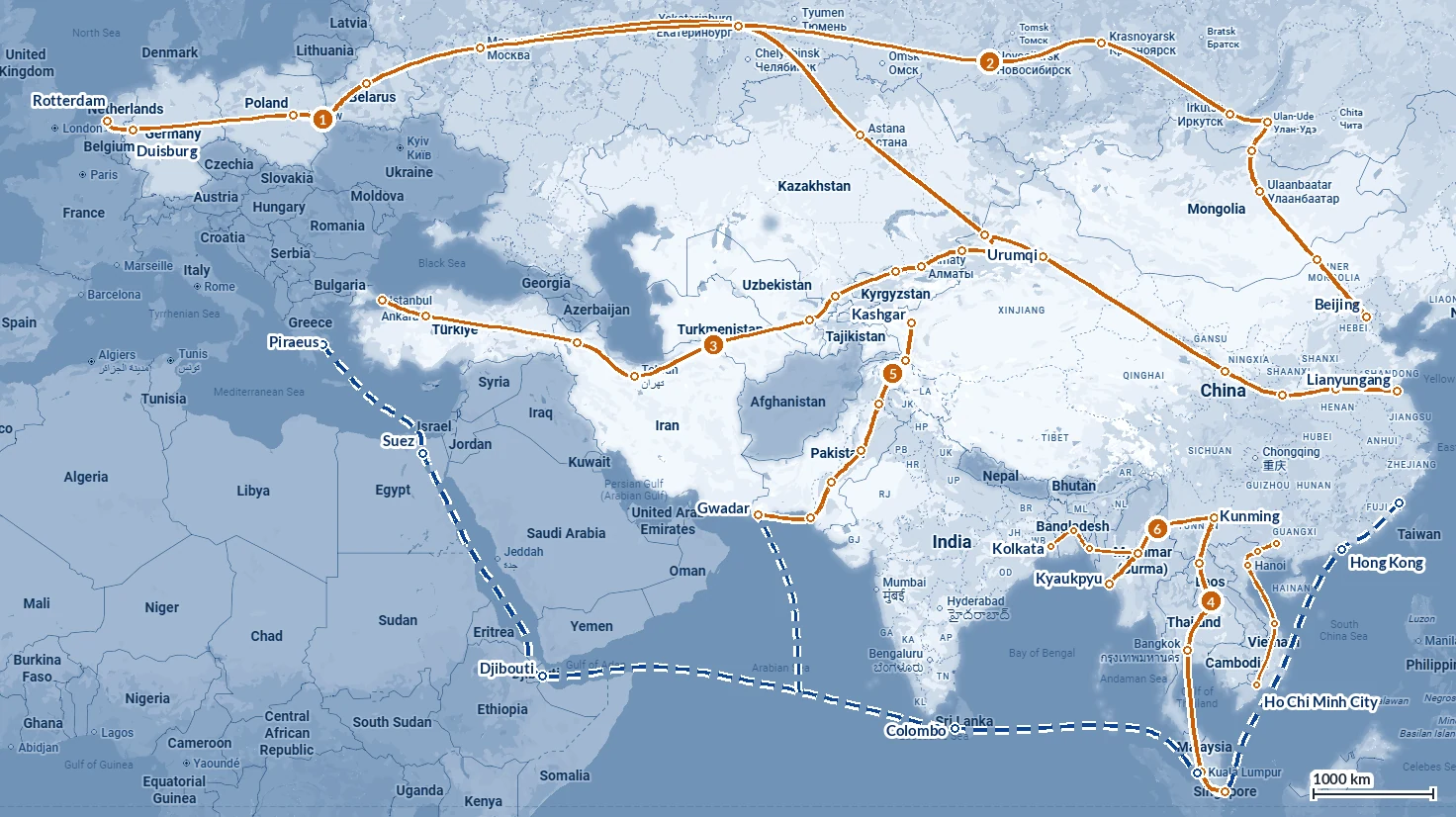
The corridor carries the goods; the agreement sets the duty
A railhead in Duisburg is worth little to a shipper who still pays the ordinary tariff at the other end
The Belt and Road is usually described as infrastructure — ports, railways, roads. The part that matters to a European company shipping goods is the legal layer laid over it. China has 23 free-trade agreements in force, covering 30 countries and regions; the large majority of its partners are also signatories of the initiative. Where the two overlap, a corridor becomes a commercial route rather than a construction project: the train reaches the border, and the agreement decides what it pays to cross it.
The reverse case is the one to watch. Several of the busiest corridors run through countries with no Chinese trade agreement at all — the whole Russian and Belarusian stretch of the Eurasian land bridge, and the Central Asian republics along corridor 3. On those, the infrastructure exists and the tariff does not move.
Where the agreements actually are
ASEAN, Hong Kong, Macao, South Korea, Australia, New Zealand, Singapore, Pakistan, Chile, Peru, Costa Rica, Switzerland, Iceland, Georgia, Maldives, Mauritius, Cambodia, Nicaragua, Ecuador, Serbia — plus RCEP, which folds fifteen economies into one rule of origin.
And where they are not
No agreement with the European Union, none with Russia, none with India, none with the Gulf states, none with the United States. Corridors 1, 2 and 3 — the whole overland route to Europe — cross no Chinese free-trade area between the Chinese border and Warsaw.
Iceland and Switzerland are the European exception
Two European countries have a bilateral agreement with China, both in force since 1 July 2014, and neither is in the European Union. The Swiss upgrade was concluded on 21 August 2026 as a memorandum; the protocol itself has not been signed.
RCEP is the one that changed the arithmetic
In force for China since 1 January 2022, it puts China, Japan, South Korea, Australia, New Zealand and the ten ASEAN states under a single set of origin rules — so a component made in one member counts as originating in all of them. For a European group with plants in both China and Vietnam, that is the provision worth modelling.
What a European company can and cannot rely on
No agreement with the Union, no investment treaty in force, and an origin regime that still runs on paper certificates
Your Chinese subsidiary can use the agreements
A foreign-invested enterprise established in China is a Chinese enterprise for these purposes. It exports to ASEAN, Korea, Australia or the RCEP area on the same preferential terms as any domestic company — which is the principal commercial reason to manufacture in China rather than ship from Europe.
Origin is certified, not declared
China issues certificates of origin through customs and the CCPIT. Under RCEP, China reserved the right to defer exporter self-certification for up to ten years, so an authority-issued certificate remains the working assumption for goods entering China — whatever your own country’s RCEP implementation allows elsewhere.
One form per agreement
Each agreement has its own certificate and its own product-specific rules. Goods that qualify under ASEAN–China may fail under RCEP and the reverse. Where two routes reach the same market, the choice is made per consignment, not once for the company.
The negative list is what governs entry
Access to a sector is set by the national negative list — manufacturing was fully opened in the edition effective 1 November 2024 — and by the shorter free-trade-zone list. What is not on the list is open on the same terms as for a domestic investor.
Structures available to foreign investors
Since the 2020 Foreign Investment Law, most sectors are open to wholly foreign-owned structures, subject to the negative list.
Wholly Foreign-Owned Enterprise (WFOE)
The standard vehicle — 100% foreign capital
- Full control and profit repatriation
- Limited liability company under Chinese law
- Open to most sectors outside the negative list
- Registered capital adapted to the business plan
Sino-foreign Joint Venture (JV)
Restricted sectors and local market access
- Equity or cooperative JV with a Chinese partner
- Mandatory in some negative-list sectors
- Shares local networks, licences and distribution
- Requires carefully negotiated governance
Representative Office (RO)
First presence without commercial activity
- Liaison, market research and quality control only
- No invoicing, hiring through licensed agencies
- Light set-up, taxed on deemed expenses
- A scouting step before a WFOE
Foreign-Invested Commercial Enterprise (FICE)
Trading, wholesale, retail and franchising
- A WFOE variant licensed for trading and distribution
- Can import/export and invoice in RMB
- Suited to sourcing platforms and sales subsidiaries
- Often combined with a Hong Kong parent company
A classic structure for European investors combines a Hong Kong holding company with a mainland WFOE or FICE — benefiting from CEPA, the HK–China double-tax arrangement and simplified profit repatriation. Our team supports both levels of the structure.
Which structure fits your project?
Tell us in a guided questionnaire, saved in your browser as you go, and receive a fixed-fee quotation. No supporting document is asked for at this stage.
Introduce your project and get your quoteThe delta, the company, the work permit and the tax bill
Where the mainland delta and Hong Kong were designed to work as one market; what it takes to form a company there, and how long each authority actually has; how a foreign manager obtains the right to be employed; and what the company and that manager will each pay. Each comes with a note you can download and circulate.
Nine cities, plus Hong Kong and Macao
An economy the size of a large European country, inside a two-hour radius
The Greater Bay Area is not a jurisdiction. It is eleven of them working as one market: the nine delta cities of Guangdong plus the two special administrative regions — some 86 million people and around USD 2 trillion of output. For a foreign investor its interest is precise: this is the one place in China where a mainland operating company and an offshore holding company sit an hour apart and were built to work together.
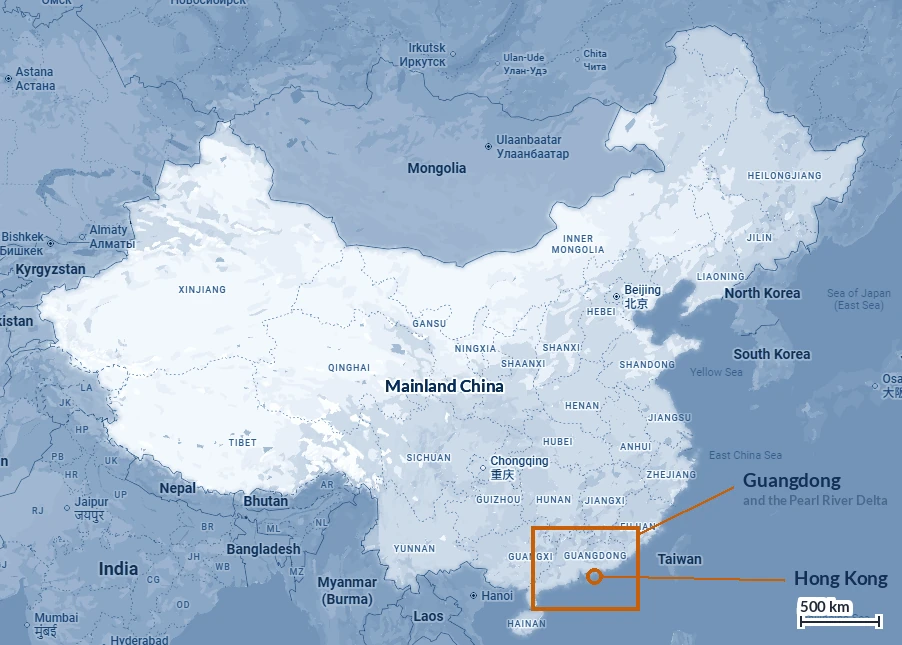
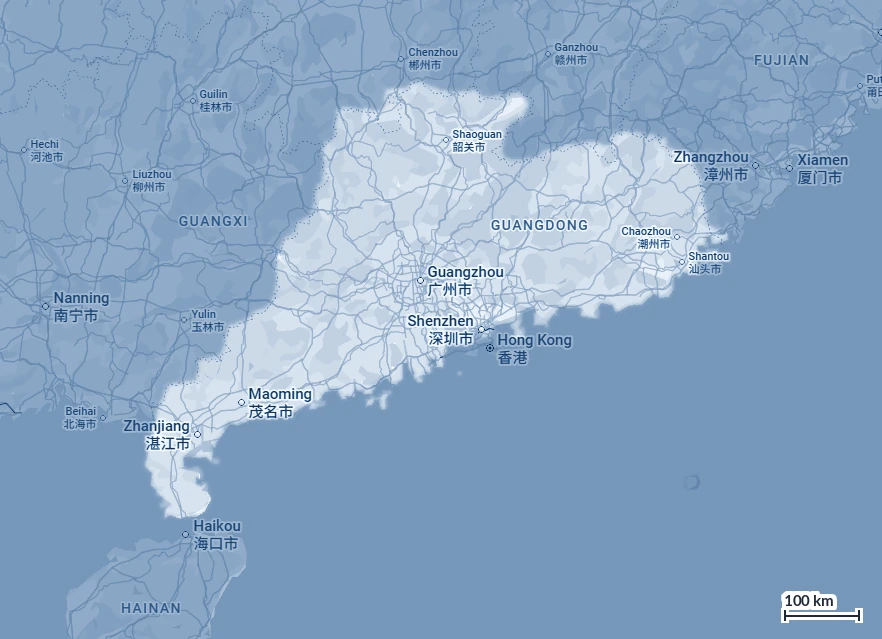
Who does what
Shenzhen is the high-technology pole — electronics, hardware, telecommunications. Dongguan is the industrial floor where much of it is assembled. Guangzhou, the provincial capital, is the all-in-one municipality: services, high technology and industry, with trade and logistics on top. Foshan carries advanced manufacturing, Zhongshan lighting and metal hardware, and Zhuhai is the aeronautical centre of the delta. Beyond them, a second ring — Huizhou, Jiangmen, Zhaoqing — where land is still available.
What made it one market
Three fixed links changed the geography rather than improving it: the Hong Kong–Zhuhai–Macao bridge and the express rail link in 2018, then the Shenzhen–Zhongshan crossing in 2024, which cut a two-hour journey to half an hour.
The talent subsidy
Across the nine mainland cities, qualifying overseas talent sees its effective individual income tax burden brought down to around 15%, the difference refunded locally. It is administered city by city, and it is the most material incentive when deciding where to put senior people.
What it means for your structure
The delta rewards two layers: a Hong Kong company that holds, funds and contracts internationally, and a mainland company that manufactures, employs and invoices domestically. Under the double tax arrangement, dividend withholding falls to 5% for a holding of at least 25%.
The wholly foreign-owned enterprise, step by step
Three working days for the licence — and four further steps on which no law imposes any deadline at all
A WFOE is a Chinese limited liability company held entirely from abroad. Since 1 January 2025 it sits under the ordinary Company Law: no separate foreign-investment statute, no ministry approval, no capital verification. What remains is a registration that is genuinely fast. What surrounds it is not, and that is the part worth understanding before committing to a date.
What the law actually times
The business licence: three working days, extendable by three. Tax registration: thirty days. Social insurance: ten working days. These are the limits the authorities are held to once a complete file has been accepted — and acceptance, not submission, is what starts the clock.
What it does not time at all
The name declaration, the seals, the bank account and the foreign exchange registration. Four steps, no deadline anywhere, and the bank alone decides. Two to five weeks is the honest observed range for the account, and a bank may simply decline.
Where foreign files fail
Not in China — in Europe. The certificate of incorporation, the resolutions, the apostilles and the sworn translations have no deadline anywhere, and an incomplete file is not suspended but returned, at which point every limit restarts from zero.
The business scope
Drawn from the official nomenclature, it limits what the company may lawfully do — unlike Hong Kong, where the description is indicative. It is worth drafting wide at the outset; amending it later is a fresh filing.
Work permit notification, Z visa and residence permit
Four documents — half obtained before the flight, half within thirty days of landing
China issues no single “work visa”. A foreign national paid by a Chinese entity passes through four instruments in a fixed order: the employer obtains the notification letter, the applicant converts it into a Z visa abroad, and the permit card and the residence permit are completed after arrival. What goes wrong is rarely the application — it is the authentication of the degree and the criminal record certificate, started too late.
Three categories, one of which matters
A for high-level talent, B for professional personnel — the ordinary category for a manager or an engineer — and C, quota-bound and much the hardest. The grade is decided by the evidence, not by the job title.
The salary pathway is back
Since early 2026 the salary route to categories A and B is strictly applied in Beijing and Shanghai: six times the local average monthly social wage for A, four times for B. The multiples are national; the wage figure is municipal and changes every year.
What hardened this year
Continuous timelines with no unexplained gaps, names in Latin letters matching the passport exactly, PDF only, and automatic termination of a permit whose extension is still pending on the expiry date. File extensions early.
Where we come in
Where the qualifications or the experience come from a Hong Kong company, we produce and attest the evidence through the China-appointed attesting officer route — which is the correct one for the mainland, and is not an apostille.
What the company pays, what the expatriate pays
One corporate rate, no provincial layer — and three personal concessions that expire on the same day
Chinese taxation is readable once two halves are kept apart. The corporate side is simple and high: 25 %, national and total, with no provincial tax on profits. The personal side is complicated and, for a foreign manager, unusually mild — but only because of concessions that carry an expiry date. Nothing in this area matters more than that date.
The small-profit threshold is a cliff
At RMB 3,000,000 of taxable profit the tax is RMB 150,000. At RMB 3,000,001 it is RMB 750,000: the whole profit reverts to 25 %, with no tapering. Guides in English still quote an effective 2.5 % on the first million — that rate expired at the end of 2022.
Getting the profit out
Withholding is 10 % as a matter of domestic law. The Mainland–Hong Kong Arrangement takes dividends to 5 % for a beneficial owner holding at least 25 % directly — the single most valuable feature of a Hong Kong holding structure, and not automatic.
Where the manager is posted changes the bill
The same RMB 720,000 package bears an effective 18.40 % in Shanghai on the itemised deductions, and 8.50 % in a Greater Bay Area city under the allowances regime. The Bay Area also absorbs about half the shock if the allowances lapse.
The six-year rule, and how to reset it
Foreign-source income paid by a foreign payer is only reached after six consecutive years of residence — and a single absence of more than thirty consecutive days resets the count to zero. It costs nothing and is forgotten most often.
Briefing notes on Mainland China
Every note is dated and written against the texts in force. Read it online, or download it as a PDF from its page.
- Establishing a New Co. in Mainland ChinaBriefing note No.1 · 29/08/2026 · How to set up a wholly foreign-owned enterprise (WFOE) in Mainland China: requirements, documents, registration steps, timeline and first-year filings.
- Working in ChinaBriefing note No.4 · 28/08/2026 · Working in Mainland China as a foreigner: the work permit notification, Z visa, permit card and residence permit, categories A to C, and the timeline.
- Taxation in Mainland ChinaBriefing note No.7 · 29/08/2026 · Taxation in Mainland China: corporate income tax at 25%, VAT, dividend withholding, and the expatriate tax concessions that end on 31 December 2027.
- The Pearl River Delta and the Greater Bay AreaBriefing note No.10 · 29/08/2026 · The Pearl River Delta and the Greater Bay Area for foreign investors: nine Guangdong cities, Hong Kong and Macao, and where a factory or office belongs.
- China's trade agreementsBriefing note No.16 · 31/08/2026 · China's free trade agreements, RCEP and the Belt and Road corridors: what they change for customs duty and origin, and what a company can rely on.
- The representative office in Mainland ChinaBriefing note No.18 · 09/09/2026 · Opening a representative office in Mainland China: what it may and may not do, who may open one, the file, the timeline, and why its tax bill is not zero.
- Verifying a Chinese business licenceBriefing note No.21 · 14/09/2026 · How to verify a Chinese business licence (营业执照): what it records, how to check it against the national register, the credit code, and the red flags.
- Investing abroad from Mainland ChinaBriefing note No.24 · 21/09/2026 · Outbound investment from Mainland China under State Council Decree No. 837: NDRC and MOFCOM filings, Hong Kong, security review, technology and fines.
- Registered capital in Mainland ChinaBriefing note No.26 · 09/10/2026 · Registered capital in Mainland China: the five-year payment rule, the 30 June 2027 deadline, abnormal capital, shareholder liability and what to check.
- Moving a WFOE to another city or provinceBriefing note No.29 · 09/10/2026 · Moving a WFOE's registered address to another city or province in Mainland China: the single application, the tax transfer, staff and what follows.