

Company registration in Taiwan
A technology powerhouse at the heart of Asian supply chains — open to foreign investment, once the investment has been approved.
Considering Taiwan for your next step?
Our team supports you at every step — feasibility study, structuring, the investment approval file, incorporation and local compliance, with Taiwanese counsel for the filings themselves.
Contact us about TaiwanLatest news — Taiwan
The IMF lifts Taiwan’s 2026 growth forecast to 10.7%
Artificial-intelligence demand makes Taiwan the fastest-growing advanced economy this year, close to the government’s own 11.05% projection.
The revised foreign professionals law has applied since 1 January 2026
Graduates of Taiwanese universities may work for two years without a permit, spouses of high-level talent may work, and permanent residence comes sooner.
Minimum wage to rise to NT$30,900 a month (about US$960) on 1 January 2027
The minimum wage review committee decided the increase on 24 September 2026: NT$205 an hour (about US$6.35), from NT$196 — at NT$32.3 to the US dollar, 16 October 2026.
A stable, innovation-driven economy at the centre of the AI supply chain

Taiwan is one of Asia’s most advanced economies, anchored by a world-leading technology sector: the island produces the majority of the world’s advanced semiconductors and hosts dense ecosystems in electronics, precision machinery and ICT. In October 2026 the IMF raised its forecast for Taiwan’s 2026 growth to 10.7%, the highest in the Asia-Pacific region and the only double-digit forecast for an advanced economy.
For foreign investors, Taiwan offers a transparent legal system, strong intellectual-property protection, a highly skilled workforce and modern infrastructure. Science parks such as Hsinchu provide dedicated regimes for research and manufacturing projects.
Foreign investment is approved in advance by the Department of Investment Review of the Ministry of Economic Affairs. Once approved, foreign investors enjoy national treatment and may repatriate their profits; the standard corporate income tax rate is 20% and VAT is 5%.
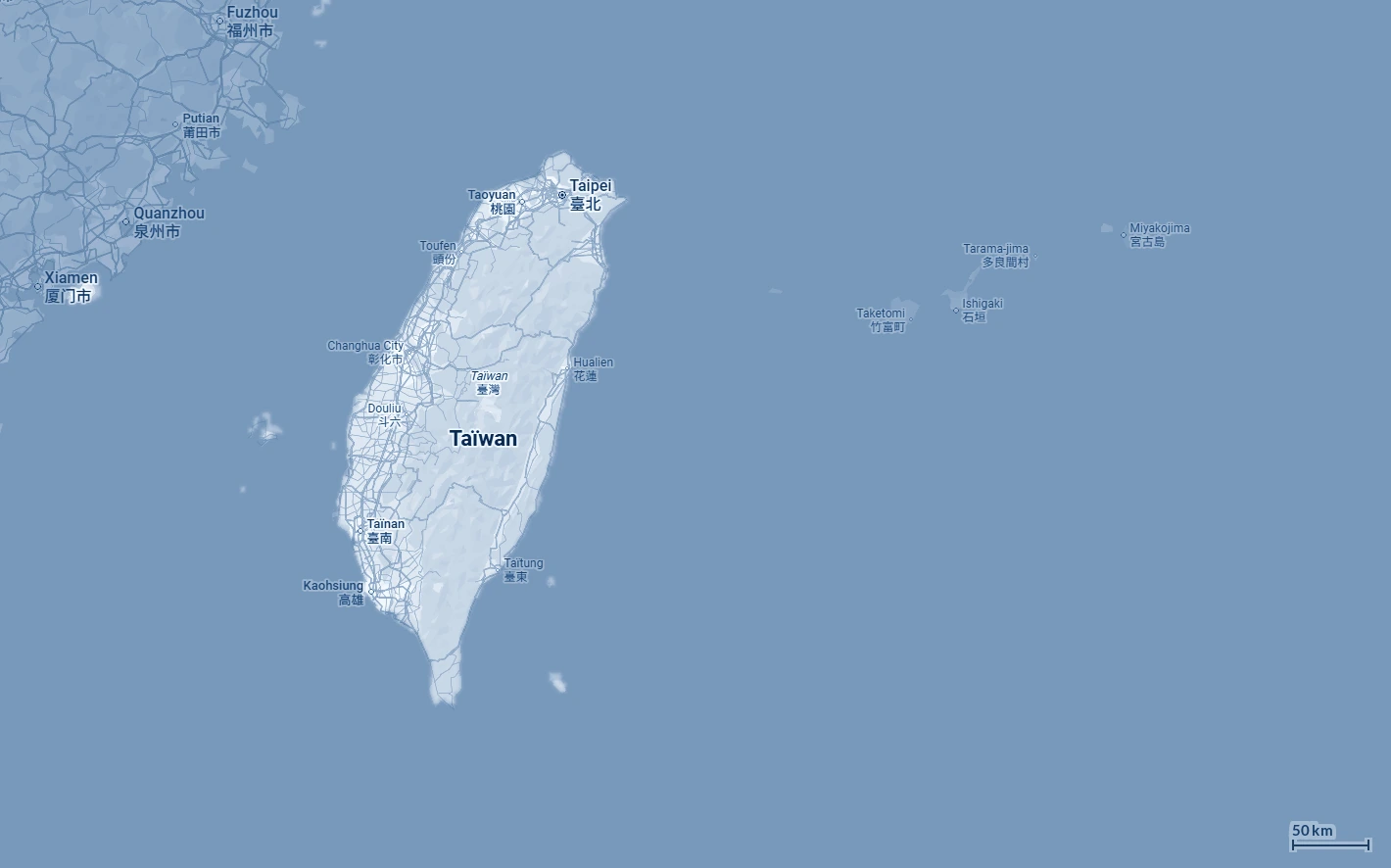
A trading economy with few treaties — and one very large neighbour
Taiwan trades as a separate customs territory, with a short list of agreements. Each one therefore weighs more than it would elsewhere, and none can be assumed.
Origin is decided by where the goods are made
A Taiwanese subsidiary exports as a Taiwanese exporter — and each preference has to be checked against the product
Taiwan applies WTO rules in its own right, and its rules of origin follow the goods, not the owner of the factory. A company incorporated in Taiwan therefore exports under Taiwan’s agreements on the same terms as any domestic company; a Hong Kong or European parent does not carry those preferences with it.
ECFA: reduced, and partly withdrawn
The 2010 agreement cut tariffs on both sides of the strait. Since 2024 Beijing has suspended its concessions on 146 of the 539 Taiwanese product lines, so a cross-strait preference can no longer be assumed: it is checked line by line, on the day of shipment.
New Zealand and Singapore
The two bilateral agreements are the island’s most complete outside the Americas. They give a Taiwanese manufacturer preferential access to two markets and, for Singapore, a gateway to the ASEAN supply chain.
The United States: signed, and moving
The Agreement on Reciprocal Trade was signed on 12 February 2026. It takes effect only when each side has completed its own legal procedures, and it commits Taiwan to reduce tariff barriers on most U.S. goods. The U.S. tariff basis itself has changed since the Supreme Court’s February 2026 ruling on emergency tariffs: confirm the rate that applies to your goods before you price a contract.
The CPTPP
Taiwan applied to join in September 2021. Accession needs the consent of every member, and it is a political decision before it is a technical one.
Structures available to foreign investors
Foreign investors choose between a subsidiary, a branch or a representative office. Only the subsidiary needs the prior investment approval.
Company Limited by Shares
The standard subsidiary for foreign groups
- Separate legal entity, limited liability
- One corporate shareholder is enough
- The only form that can be listed
- A closely held variant (up to 50 shareholders) restricts share transfers
Limited Company
Smaller wholly-owned subsidiaries
- Members’ liability limited to their contribution
- Simpler governance than a shares company
- Cannot offer its shares to the public
- A common first step for SMEs
Branch Office
Direct extension of the foreign parent
- No separate legal personality — the parent is liable
- No investment approval required
- Not subject to the retained-earnings surtax
- Profits remitted to the head office without dividend withholding
Representative Office
Liaison presence without trading
- Market research, liaison and coordination only
- No sales or invoicing in Taiwan
- No investment approval required
- A scouting structure before incorporation
Investors from Mainland China are confined to a positive list of sectors, and applications from Hong Kong investors are examined more closely. We assess the approval path applicable to your project, and the holding structure above the Taiwanese entity, before anything is filed.
Which structure fits your project?
Tell us about your project. We assess the approval path and the structure with Taiwanese counsel before any filing is made.
Contact us about TaiwanApproval, the corridor, and the right to be there
Each week until 19 December 2026 a new panel is added here, with the briefing note behind it. Every panel can be read on this page; the note gives the detail, the sources and a PDF to keep.
Investment approval and the science-park corridor
Approved before the company exists; located where the incentive is
Every foreign investment in a Taiwanese company needs the prior approval of the Department of Investment Review (DIR) of the Ministry of Economic Affairs — the former Investment Commission — under the Statute for Investment by Foreign Nationals. A branch and a representative office are the only exceptions. Approval comes first; then the capital is remitted to a preparatory account and verified; only then is the company registered, and its tax registration follows. Getting that order wrong — registering first, or remitting before approval — is the most common way a Taiwanese project loses a quarter.
Mainland and Hong Kong money
Mainland investors may only enter the sectors on the DIR’s positive list, and a company counts as mainland if mainland persons hold more than 30 % of it, at any level of the chain, or control it. An unapproved mainland investment carries fines of up to NT$25 million (about US$770,000, at NT$32.3 to the US dollar, 16 October 2026) and can end in forced divestment. Applications from Hong Kong investors are examined more closely and take longer — so a Hong Kong holding company is a choice to test against the DIR, not a default.
A short list, and sector laws behind it
The negative list under the Statute is short. Most of Taiwan’s real ownership limits sit in the laws that govern a given sector — telecommunications, broadcasting, air transport — so the sector law has to be read as well as the list.
Location is the incentive
The science-park corridor runs down the western plain. Hsinchu for semiconductors, IC design and optoelectronics; central Taiwan for precision machinery, machine tools and aerospace parts; southern Taiwan for advanced packaging, biotechnology and medical devices. Admission to a park carries facilities, land arrangements and, for qualifying activities, tax treatment.
The R&D credit follows the work
Under the Statute for Industrial Innovation, amended in May 2025 to add artificial intelligence and energy saving, qualifying research expenditure earns a credit against income tax. The list of eligible sectors was updated on 23 October 2025 and covers semiconductors, electric vehicles, communications and display technologies. The credit rewards work actually performed in Taiwan.
The founder’s own position
The ordinary work permit requires the Taiwanese employer to exist first, which puts a founder in a circle. The Employment Gold Card breaks it. The next note in this series, on 24 October, takes the two routes in turn.
What we do, and what we don’t
We have no Taiwanese establishment and say so. We test whether the activity belongs in Taiwan at all, the holding structure above the Taiwanese entity, the group’s compliance file, and the coordination of Taiwanese counsel, whose filings remain theirs.
Briefing notes on Taiwan
Ten notes in all, one every Saturday until 19 December 2026. Every note is dated and written against the texts in force. Read it online, or download it as a PDF from its page.
- Taiwan: investment approval and the science-park corridorBriefing note No.13 · 17/10/2026 · Foreign investment in Taiwan: the prior approval of the Department of Investment Review, the order of registration and remittance, mainland and Hong Kong investors, and where the science parks put the incentive.
- Taiwan's economy and the AI supply chainBriefing note No.39 · 17/10/2026 · Taiwan's economy for a foreign investor: growth and the AI cycle, exports and markets, semiconductors and servers, labour, energy and the currency.
- Working in TaiwanComing 24 October 2026 · Working in Taiwan as a foreigner: the employer's work permit and the Employment Gold Card, the 2026 reform of the foreign professionals law, and the tax incentive.
- Establishing a New Co. in TaiwanComing 31 October 2026 · How to set up a company in Taiwan: forms, approval, registration steps, timeline and first-year filings.
- Taxation in TaiwanComing 7 November 2026 · Taxation in Taiwan: corporate income tax, the retained-earnings surtax, VAT, dividend withholding and the personal tax of expatriates.
- Taiwan's trade agreementsBriefing note No.32 · 17/10/2026 · Taiwan's trade agreements: its WTO status, ECFA, the agreements with New Zealand and Singapore, the United States, and what a company can rely on.
- The branch and the representative office in TaiwanBriefing note No.33 · 17/10/2026 · Opening a branch or a representative office in Taiwan: what each may and may not do, how to register one, and how each is taxed.
- Verifying a Taiwanese companyComing 28 November 2026 · How to verify a Taiwanese company: the public registry, the unified business number, what the records show and the red flags.
- Capital in TaiwanComing 5 December 2026 · Capital in a Taiwanese company: no statutory minimum, paid-in capital, capital verification and what shareholders answer for.
- Investing abroad from TaiwanComing 12 December 2026 · Outbound investment from Taiwan: the approval regime, the special rules for Mainland China, and the thresholds.
- Moving a company in TaiwanComing 19 December 2026 · Moving a Taiwanese company to another address or city: the filings, the tax registration and what follows.