

Taiwan’s economy and the AI supply chain
Growth, exports and markets, chips and servers, people, power and the currency — what the figures say before a project is placed in Taiwan
In 2026 Taiwan is growing faster than at any time in almost forty years, on the strength of one cycle: the build-out of artificial intelligence, whose chips and servers are largely made on the island. That is the opportunity, and it is also the concentration a foreign investor has to price. This note sets out the figures that matter for a project — growth, trade, the technology base, investment, labour, power and money — as published by the authorities in October 2026.
How fast is Taiwan growing?
The economy grew 8.63 percent in 2025, the fastest pace since 2010, and accelerated in 2026: output rose 14.15 percent year on year in the first half, and 12.93 percent in the second quarter. In August the Directorate-General of Budget, Accounting and Statistics raised its forecast for 2026 to 11.05 percent, the highest in thirty-nine years, and expects 6.04 percent in 2027. The International Monetary Fund followed on 13 October 2026 with 10.7 percent for 2026, against 5.2 percent in April — the highest forecast in the Asia-Pacific region, and the only double-digit forecast for an advanced economy. The figures are exceptional because demand for AI hardware is exceptional: a plan that relies on them should be tested against a normal year.
What does Taiwan sell, and to whom?
Exports reached a record US$640.7 billion in 2025, up 34.9 percent, and US$661.6 billion in the first nine months of 2026 alone — more than in the whole of the previous year. September 2026 was the best month on record, at US$87.2 billion, and the thirty-fifth consecutive month of growth. Two product groups carry the trade: information, communication and audio-video products, which include servers, made up 39.2 percent of exports in 2025, and electronic components, chiefly chips, 34.8 percent. In September 2026 the two together reached 80.5 percent.
| Market | Share of exports, 2025 | What changed |
|---|---|---|
| United States | 30.9% | Taiwan’s largest market over a full year for the first time since 2000; about 31 percent again in January–September 2026. |
| Mainland China and Hong Kong | 26.6% | The lowest share in about twenty-five years, and second place. |
| ASEAN | 18.6% | Rising: about 20 percent of exports in January–September 2026. |
Europe took 6.4 percent of exports in 2025 and Japan 4.7 percent. The shift towards the United States and South-East Asia follows the servers: they are shipped where the data centres are built.
Where do the chips and the servers come in?
Taiwan’s companies sit at two points of the AI supply chain that few others can fill. The first is the manufacture of advanced chips: in the second quarter of 2026 TSMC alone took 72.5 percent of the revenue of the world’s ten largest foundries, according to TrendForce, and nodes of seven nanometres and below brought it 74 percent of its wafer revenue in 2025, when its sales reached US$122.4 billion. The second is the assembly of the machines those chips go into: Taiwanese manufacturers build about 90 percent of the world’s AI servers, on the estimate of the Market Intelligence & Consulting Institute.
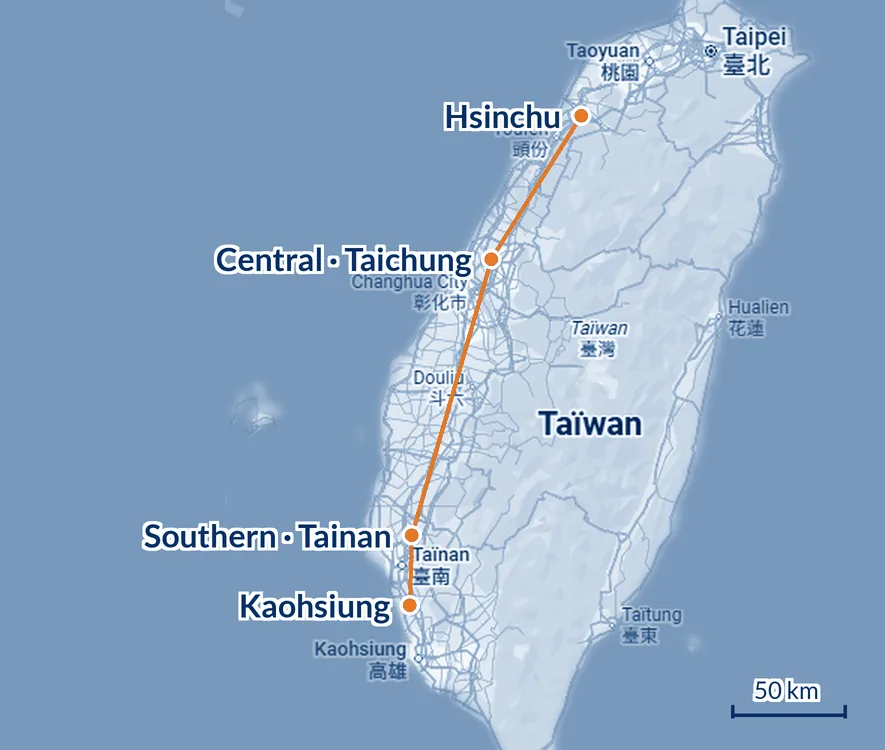
The three science parks hold most of that activity. They reported revenue of NT$5.8 trillion in 2025 (about US$180 billion, at NT$32.3 to the US dollar, 16 October 2026), 83 percent of it from integrated circuits, with 1,171 companies and more than 340,000 employees. The Southern park, around Tainan and Kaohsiung, has become the largest by revenue; Hsinchu remains the historical centre of chip design and process development.
Process technologies below 14 nanometres are listed as core key technologies under the National Security Act, and investment abroad in the industry is reviewed by the Ministry of Economic Affairs. A foreign company that licenses, develops or recruits in these fields in Taiwan should expect the same scrutiny on anything it wants to take out: the question belongs in the plan, not in the exit.
Who is investing?
Approved foreign direct investment reached US$11.39 billion in 2025, in 2,216 cases, driven by offshore wind and technology groups. It almost doubled in 2026: the Department of Investment Review approved US$19.23 billion in the first nine months, in 1,718 cases, with a capital increase by Micron of about US$9.45 billion accounting for half of the total and the offshore-wind developers Ørsted and Hai Long for more than US$2 billion between them. Investment from Mainland China remained marginal, at 17 cases and US$8.56 million. Electronic components took more than half of approved investment in the first seven months of the year, and finance and insurance about a sixth.
Who will do the work?
The population fell to 23.21 million at the end of September 2026, its thirty-third consecutive monthly decline, and Taiwan became a super-aged society in 2025, when the share of residents aged sixty-five or over passed 20 percent. The labour force is about 12 million, unemployment is low, and engineers are contested by the chipmakers themselves. Labour costs are rising from the bottom: the monthly minimum wage is NT$29,500 in 2026 (about US$910) and rises to NT$30,900 (about US$960) on 1 January 2027; the hourly minimum goes from NT$196 to NT$205 (about US$6.10 and US$6.35).
Where a project settles decides who it can hire. Near the parks, salaries are set by the semiconductor industry; away from them, engineers are cheaper but scarcer. Foreign hires are possible, through employer permits or the Employment Gold Card, and are the subject of the note Working in Taiwan.
Is there enough power?
Electricity is the constraint the growth figures do not show. Taiwan closed its last nuclear reactor, at Maanshan, in May 2025; a referendum on restarting it, held on 23 August 2025, won a majority of the votes cast, but the yes vote fell short of the required quarter of the electorate. The Nuclear Safety Commission completed its review of a restart plan in September 2026, and the government gives 2028 as the earliest restart date. In 2025 gas produced 47.8 percent of the island’s power, coal 35.4 percent and renewables 13.1 percent, short of the 20 percent target. Industrial tariffs rose by an average of 12.5 percent in October 2024 and were held unchanged at the September 2026 review.
For a plant, a laboratory or a data facility, the supply that Taiwan Power Company can commit at the chosen site, and the timetable of the connection, should be confirmed in writing before the site is secured. Large new loads are reviewed, and the answer differs from one industrial area to the next.
The currency and the cost of money
The New Taiwan dollar
The currency stood at NT$32.34 to the US dollar at the close on 16 October 2026. Exporters and investors earn in dollars and spend in New Taiwan dollars: a capital budget, a payroll or a lease priced locally moves with the exchange rate, and the capital approved for a foreign investment is remitted in foreign currency and converted on arrival.
Rates and ratings
The Central Bank held its discount rate at 2 percent on 17 September 2026. Taiwan is rated AA+ by S&P, Aa3 by Moody’s and AA by Fitch, all with a stable outlook in 2026. Its public finances are not the issue for an investor; the agencies point instead to geopolitical risk.
What should a foreign investor take from the figures?
Taiwan rewards projects that belong in its supply chain: research, design, testing, components, equipment and services for the industries the parks host, and the energy transition that has to power them. It is a harder case for activities that need cheap land, cheap labour or unlimited electricity. And whatever the activity, the investment is approved before the company exists — the order of approval, capital and registration is the subject of the note Taiwan: investment approval and the science-park corridor.
How we work on Taiwan
Lo On Shing does not maintain a Taiwanese establishment. We assess whether a project belongs in Taiwan, structure the holding above the Taiwanese entity and coordinate Taiwanese counsel for the approval and registration; where a project does not fit Taiwan, we say so before the costs are committed.
Terms you will meet
| Term | What it is |
|---|---|
| Directorate-General of Budget, Accounting and Statistics (DGBAS) 行政院主計總處 | The statistics office of the Executive Yuan: national accounts, prices, employment and the official growth forecasts. |
| Science park 科學園區 | An industrial zone administered by the National Science and Technology Council, with its own admission rules, facilities and procedures. |