

Company registration in Vietnam
South-East Asia’s rising hub — a booming market increasingly open to foreign investors.
Ready to launch your business in Vietnam?
Our team supports you at every step — feasibility study, structuring, incorporation and local compliance.
Introduce your project and get your quote Contact usLatest news — Vietnam

What are the different types of visas in Vietnam?
Business visas, work permits and residence cards: the routes available to foreign founders and employees.

Vietnam, a strategic market since the EU free-trade agreement
EVFTA progressively removes tariffs between the EU and Vietnam and strengthens investor protection.

Steps and timeline to incorporate in Vietnam
IRC, ERC, bank account and compliance: a company is typically operational in 5 to 7 weeks.
A booming market for foreign investors

Vietnam has become one of South-East Asia’s most attractive destinations for international entrepreneurs. Sustained economic growth — around 6% on average over the last decade — a young and skilled workforce and an increasingly favourable regulatory framework make it a credible alternative to China for manufacturing, services and trade.
The country multiplies bilateral and regional agreements (RCEP, EVFTA, ASEAN) and keeps simplifying procedures for foreign-invested enterprises. Preferential tax treatment applies in certain zones — export processing, high-tech and priority sectors.
Since the 2020 Investment Law, it is possible to incorporate with 100% foreign capital in the vast majority of sectors, without any local partner. Some regulated activities still require a Vietnamese partner or special approval — our feasibility study identifies these constraints before you commit.
Seventeen trade agreements in force
Vietnam is the most heavily networked economy in South-East Asia. For a European company that changes two things at once: what a Vietnamese subsidiary can sell abroad duty-free, and what it costs to supply that subsidiary from home.
Bilateral
Negotiated country to country
- European Union — EVFTA, in force 1 August 2020
- United Kingdom — UKVFTA, in force 1 May 2021
- Japan — VJEPA, 2009
- South Korea — VKFTA, 2015
- Chile — VCFTA, 2014
- Eurasian Economic Union — Russia, Belarus, Kazakhstan, Armenia, Kyrgyzstan, 2016
- Israel — VIFTA, in force 17 November 2024
- United Arab Emirates — CEPA, in force 3 February 2026
Through ASEAN
Preferential access Vietnam holds as a member
- China — ACFTA; the 3.0 upgrade protocol was signed on 28 October 2025 and is not yet in force
- India — AIFTA; the goods chapter is under review
- Japan — AJCEP, alongside the bilateral agreement
- South Korea — AKFTA
- Australia and New Zealand — AANZFTA, upgraded for Vietnam on 22 August 2025
- Hong Kong — AHKFTA and its investment agreement, both in force since 12 February 2021
- and the internal ASEAN market itself, under ATIGA
The two large blocs
Where Vietnam sits with a dozen partners at once
- CPTPP, in force for Vietnam since 14 January 2019 — twelve parties: Australia, Brunei, Canada, Chile, Japan, Malaysia, Mexico, New Zealand, Peru, Singapore, the United Kingdom (since 15 December 2024) and Vietnam
- RCEP, in force for Vietnam since 1 January 2022 — the ten ASEAN states with China, Japan, South Korea, Australia and New Zealand; the largest trade agreement in the world by population
- Negotiations with the EFTA states — Switzerland, Norway, Iceland, Liechtenstein — were concluded on 2 July 2026. The agreement is not yet signed.
EVFTA: what a European exporter actually pays in 2026
Six years into a ten-year schedule — most of the cuts have happened, and the largest remaining step falls on 1 January 2027
The EU–Vietnam Free Trade Agreement has been in force since 1 August 2020. Vietnam removed its duty on 48.5% of tariff lines that day — 64.5% of what it buys from Europe by value — and is phasing out the rest: 91.8% of lines are duty-free from 1 January 2027, and 98.3% from 1 January 2030. In the other direction the EU went further and faster: 85.6% of lines free on day one, and 99.2% from 1 January 2027.
Duties do not fall on the anniversary of the agreement. They fall on 1 January of each year, in equal annual steps set out in Annex 2-A. A shipment held back three weeks in December therefore clears at next year’s rate.
| Goods | HS | Ordinary duty | Under EVFTA in 2026 | Duty-free from |
|---|---|---|---|---|
| Electric motors, 1–37.5 kW | 8501.52 | 10% | 0% | already |
| Air-conditioning machines | 8415.10 | 20% | 0% | already |
| Beef, frozen and boneless | 0202.30 | 14% | 0% | already — since 1 Jan 2023 |
| Milk powder, bulk | 0402.21 | 2% | 0% | already — since 1 Jan 2025 |
| Motor-vehicle parts | 8708.99 | 15% | 1.8% | 1 January 2027 |
| Pork, frozen | 0203.29 | 10% | 1.8% | 1 January 2027 |
| Perfumes and toilet waters | 3303.00 | 18% | 2.2% | 1 January 2027 |
| Spirits — vodka, brandy | 2208 | 45% | 6.0% | 1 January 2027 |
| Wine, over 23% vol., in bottle | 2204.21 | 50% | 6.2% | 1 January 2027 |
| Motorcycles over 800 cm³ | 8711.50 | 40% | 6.8% | 1 January 2027 |
| Chicken, frozen cuts | 0207.14 | 20% | 7.2% | 1 January 2030 |
| Cars, over 3,000 cm³ | 8703.24 | 45% | 20.4% | 1 January 2029 |
| Cars, estate and sports | 8703.80 | 70% | 28.3% | 1 January 2030 |
Rates read on the Vietnamese schedule in force for 2026 (Decree 116/2022/ND-CP and the tariff database that publishes it), line by line. Duties are set per eight-digit code, not per family: the lines above are representative, and yours must be checked against its own code before you price anything.
The preference is not automatic
It is claimed, with a proof of origin, and refused without one. A European exporter registered in the REX system self-certifies with a statement on the invoice; below €6,000 per consignment any exporter may do so unregistered. Vietnamese exporters still use the paper EUR.1 certificate above that threshold.
Claim it at the border, not after
The EU accepts a retrospective claim after clearance. Vietnam does not: the proof is produced on import, with a short grace period if it is not yet to hand. A proof of origin is valid twelve months.
Origin is a manufacturing test
Repackaging, labelling and simple assembly confer nothing. Garments are the classic trap: the fabric itself must originate, not merely be cut and sewn in Vietnam — though fabric from South Korea has counted as originating since December 2020.
Zero duty is not free entry
Two European regimes now apply to Vietnamese goods whatever the tariff: the carbon border mechanism, in its definitive phase since 1 January 2026, and the deforestation regulation, which bites on larger importers of coffee, rubber, wood and their derivatives from 30 December 2026.
Structures available to foreign investors
The 2020 Investment Law opened most sectors to fully foreign-owned structures. The right form depends on your activity, sector and investment size.
Limited Liability Company (LLC)
The most common form — 100% foreign capital possible
- Single-member or multi-member (2–50)
- Liability limited to contributed capital
- Requires an Investment Registration Certificate (IRC) and Enterprise Registration Certificate (ERC)
- Suited to manufacturing, services and trading
Joint Stock Company (JSC)
Larger projects and future capital raising
- Minimum three shareholders, shares freely transferable
- Can list on Vietnamese stock exchanges
- Heavier governance (board, supervisory rules)
- Suited to ventures with several investors
Representative Office
Market presence without commercial activity
- Fast and inexpensive to open
- Market research, liaison and promotion only
- No invoicing or revenue-generating activity
- A first step before full incorporation
Branch / Business Cooperation Contract
Specific regulated projects
- Branch: direct extension of the foreign parent (limited sectors)
- BCC: contractual cooperation with a Vietnamese partner, no new entity
- Used for education, media and other restricted activities
- Requires case-by-case approval by the authorities
Certain sectors (education, press, some regulated professions) still require a Vietnamese partner or special approval from local authorities. Our on-the-ground team in Vietnam coordinates notaries, lawyers and authorities, and stays at your side from the IRC/ERC through to bank account, tax registration and recruitment.
Which structure fits your project?
Tell us in a guided questionnaire, saved in your browser as you go, and receive a fixed-fee quotation. No supporting document is asked for at this stage.
Introduce your project and get your quoteFour questions we are asked every week
Where the industry actually is, what it takes to form a company under a framework rebuilt between 2025 and 2026, how a foreign manager gets the right to work there, and what a tax code rewritten in fifteen months now charges. Each comes with a note you can download and circulate.
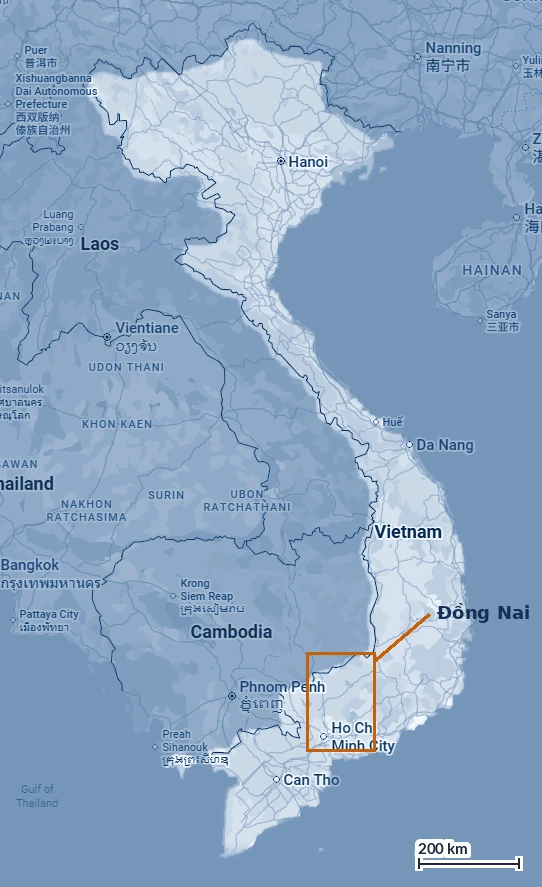
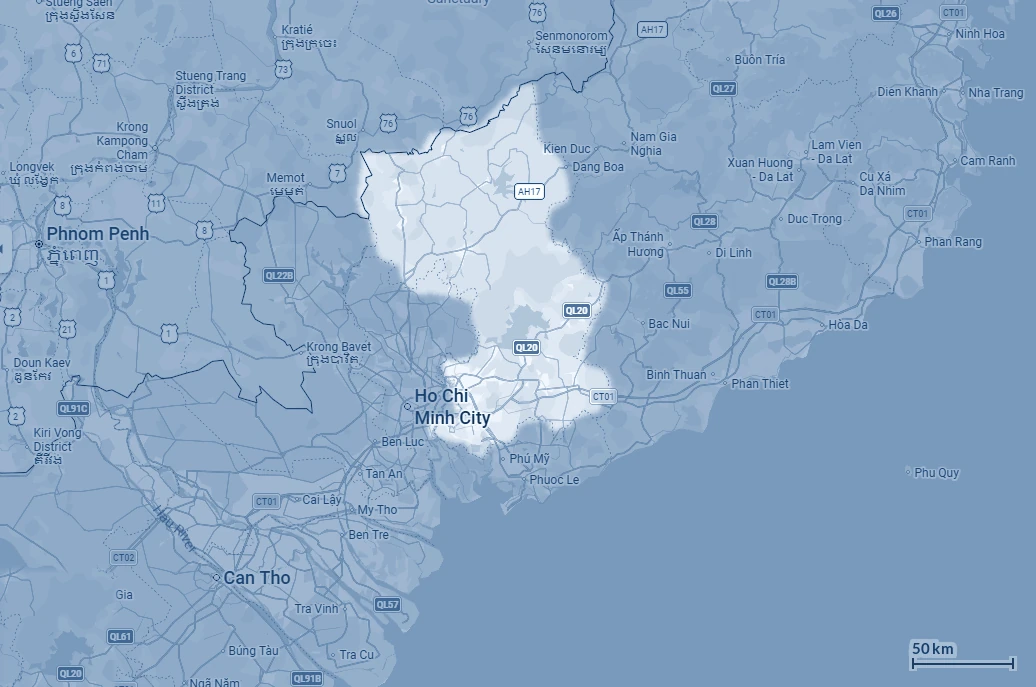
Đồng Nai — Vietnam’s first industrial basin
Half an hour east of Ho Chi Minh City, and now the site of the country’s new international airport
Đồng Nai changed status twice in under a year: merged with the former province of Bình Phước on 1 July 2025, then raised to the rank of centrally-run municipality on 30 April 2026 — the country’s seventh. The substance has not moved: this remains the densest concentration of foreign manufacturing in southern Vietnam.
Where the industry sits
Biên Hòa I & II and Amata at the historic core; Nhơn Trạch as the densest pole; Lộc An–Bình Sơn beside the new airport; Bàu Xéo, Giang Điền and Sông Mây as the relocation basin.
What the sectors are
Electronics and components, textiles and footwear, mechanical engineering and automotive parts, wood and furniture, food processing, chemicals — and, growing with the airport, logistics.
What the reform changed for your file
The district tier was abolished: administration runs on two levels, municipality and commune. A lease or a licence issued before July 2025 may name a district that no longer exists — addresses have to be restated before filing.
How we work there
Through our strategic partnership with Giang Nam 3V Law Firm, whose office is at Trảng Bom, at the centre of the Giang Điền industrial basin. Vietnamese-law filings run through that partnership; structuring and the Hong Kong layer stay with us.
The foreign-owned limited liability company, step by step
Two certificates, ninety days to fund the company — and a legal framework rebuilt between 2025 and 2026
Vietnam has replaced most of the law governing this subject in eighteen months. The Law on Enterprises was amended with effect from 1 March 2026, business registration was recast by decree in 2025 and amended again in 2026, the capital account rules were reissued in August 2026, and the licence tax was abolished on 1 January 2026. Any guide written before mid-2026 is now wrong in several places.
A choice that is new
The investment certificate no longer has to come first. Under the framework now in force the enterprise certificate may be taken first, with the investment certificate to follow within twelve months — useful where the company must exist before the project is fully defined.
An apostille is now enough
Since 11 September 2026 Vietnam has been party to the Hague Apostille Convention: a document issued in a contracting state needs only an apostille, then a sworn Vietnamese translation — two to three weeks rather than four to six. Consular legalisation remains for states outside the Convention and for those that objected to Vietnam’s accession, Germany, Austria and the Czech Republic among them. This leg is still entirely outside Vietnamese administrative control, which is why we start it first.
The province decides more than you think
Both certificates are issued at provincial level, and a project inside an industrial zone is handled by the zone’s own management board. The choice therefore governs the incentives available and which office reads the file — and practice differs measurably.
Conditional sectors
Trading and distribution, retail, education, logistics and food each require their own sub-licence after the enterprise certificate, often longer than the incorporation itself. A retail outlet is examined against an economic needs test. Worth establishing before anything is filed.
Work permit, LD2 visa and residence card
Three documents, in one order that cannot be rearranged
A foreign national paid by a Vietnamese entity needs a work permit, applied for by the employer. That permit opens the LD2 working visa, and the LD2 visa opens the temporary residence card. Each is the condition of the next — most failed applications come from someone trying to start in the middle.
The framework
Decree 219/2025/NĐ-CP, in force since 7 August 2025. The “expert” route rests on qualifications and on documented professional experience, evidenced by the previous employer — often a company outside Vietnam.
The realistic timeline
Eight to ten weeks from start to residence card. The permit and the visa are the milestone that matters; the card often follows a few weeks later, and that delay does not stop the person working.
The step that trips people up
Authentication abroad. Since 11 September 2026 an apostille is enough for documents from most European states; Germany, Austria and the Czech Republic objected to Vietnam’s accession, so their documents still go through the full consular circuit. Either way the circuit has to be complete, and two circuits must not be mixed within one document.
Where we come in
Where the professional experience comes from a Hong Kong company, we produce and legalise the evidence — certificate of incumbency, written resolution, annual return and a signed attestation — through the Hong Kong chain.
Four tax laws replaced in fifteen months
Corporate, VAT, personal and excise — all superseded between June 2025 and January 2026
Vietnam has rewritten its tax code from top to bottom. The implementing decrees and circulars followed by 30 June 2026, and a new National Assembly now numbers its statutes /QH16. The practical consequence is blunt: almost every English-language summary written before mid-2026 is wrong in several places, including some usually reliable ones.
No withholding, but three conditions
Dividends to a foreign company bear no Vietnamese withholding. Remittance still requires audited accounts and the annual finalisation filed, seven working days’ notice, and no unabsorbed accumulated losses — even in a profitable year.
Exits changed shape
Since 15 December 2025 a capital transfer by a foreign corporate seller bears 2 % of the sale price, direct and indirect transfers alike, in place of 20 % on the net gain. A structural change for anyone planning an exit.
Above VND 175m a month, non-residence is cheaper
A non-resident pays a flat 20 % on Vietnamese-source employment income with no allowances; a resident pays the progressive scale with them. The curves cross around VND 175–180m a month with one dependant — worth settling before the assignment, not after.
Two dates that will move on their own
The temporary 8 % VAT reverts to 10 % on 1 January 2027 unless extended, and the transitional Pillar Two safe harbours end on 31 December 2026. Both should be in the plan rather than in the surprise.
Giang Nam 3V Law Firm — your Vietnamese legal team
Lo On Shing Consultants works in cooperation with Giang Nam 3V Law Firm, established in Đồng Nai — Vietnam’s leading centre for foreign industrial investment. Together we cover the full lifecycle of a foreign-related EPC or investment project, in Vietnamese, English and French.
01 · Origination
- Site & land due diligence
- Land-use rights and title review
- Industrial-zone entry conditions
- Investment certificate filing
02 · Permitting
- Construction permits
- Regulatory approvals
- Environmental compliance
- Administrative filings
03 · Contracting
- EPC contracts & subcontracts
- Procurement & supply terms
- Risk & liability allocation
- FIDIC adaptation to Vietnamese law
04 · Delivery & disputes
- Claims & variations
- Negotiation & mediation
- Litigation & enforcement
- Police & procuracy representation
Fixed-fee quotations, bilingual work product (Vietnamese and English, French through Lo On Shing), senior review of every deliverable and a direct link between Đồng Nai and our Hong Kong office.
Briefing notes on Vietnam
Every note is dated and written against the texts in force. Read it online, or download it as a PDF from its page.
- Establishing a New Co. in VietnamBriefing note No.3 · 09/10/2026 · Setting up a foreign-owned LLC in Vietnam under the 2025–2026 reforms: IRC and ERC, charter capital, documents, procedure and first-year obligations.
- Working in VietnamBriefing note No.6 · 30/09/2026 · Working in Vietnam as a foreigner: work permit, LD2 visa and temporary residence card — the order, the documents, a realistic timeline and the costs.
- Taxation in VietnamBriefing note No.9 · 29/08/2026 · Taxation in Vietnam after the 2025–2026 rewrite of the tax laws: corporate income tax, VAT, foreign contractor tax and personal income tax, with examples.
- Đồng Nai provinceBriefing note No.12 · 28/08/2026 · Investing in Đồng Nai, Vietnam: industrial zones, labour, logistics, the new Long Thành airport and the 2025–2026 administrative reform, for investors.
- Vietnam's trade agreementsBriefing note No.15 · 31/08/2026 · Vietnam's free trade agreements: EVFTA, CPTPP and RCEP — preferential duty, rules of origin, and what the EU agreement means for an exporter in 2026.
- The representative office in VietnamBriefing note No.19 · 09/09/2026 · Opening a representative office in Vietnam: the five-year licence, permitted activities, the file and its legalisation, timeline, taxes and the PE risk.
- Why does the United States buy more from Vietnam than from China?Briefing note No.20 · 11/09/2026 · US tariffs on Vietnamese goods in 2026: the tariff sequence, the Section 301 duty, and the origin a manufacturer in Vietnam must now be able to prove.
- Verifying a Vietnamese companyBriefing note No.23 · 15/09/2026 · How to verify a Vietnamese company: the enterprise and investment registration certificates, the three capital figures, the public registers and red flags.
- Trading and retail in VietnamBriefing note No.25 · 08/10/2026 · Trading and retail in Vietnam under Decree No. 342/2026/ND-CP from 18 October 2026: the Business Licence, retail outlet licences, the economic needs test.
- Beneficial owners of a Vietnamese companyBriefing note No.27 · 09/10/2026 · Beneficial owners of a Vietnamese company under Decree No. 296/2026/ND-CP: the 25% tests, look-through of foreign holdings, the declaration and the fines.