

Verifying a Vietnamese company
The two certificates a foreign-invested company holds, the three capital figures they carry between them, and what the public registers will and will not tell you
Download this note as a PDF Version française (PDF)
A Vietnamese counterparty sends its enterprise registration certificate and the file feels closed. It is not. The certificate does not say what the company is allowed to do, it does not say that a single dong of its capital was ever paid in, and since 2015 it does not even list its business lines. A foreign-invested company holds a second certificate that answers some of those questions, and two separate public registers answer others — one of which will tell you the company is trading while the other says the tax authority went to the address and found nobody. This note sets out what each document records, how to read the two registers against each other, and where the Vietnamese record simply stops.
Two certificates, and which one the company actually holds
Vietnam separates the company from the project. The enterprise registration certificate — giấy chứng nhận đăng ký doanh nghiệp, the ERC — creates the legal person. The investment registration certificate — giấy chứng nhận đăng ký đầu tư, the IRC — authorises a project and is required of foreign investors. A wholly domestic company holds one document. A foreign-invested company normally holds both, and they say different things.
| Enterprise registration certificate | Investment registration certificate | |
|---|---|---|
| What it creates | The legal person. Without it there is no company. | Nothing. It authorises a project; it does not incorporate anything. |
| Issued by | The business registration office of the provincial Department of Finance — Sở Tài chính since the 2025 reform. | The provincial Department of Finance, or the management board of the industrial, export-processing, high-tech or economic zone where the project sits. |
| Under | Law on Enterprises 59/2020/QH14, as amended by Law 76/2025/QH15; Decree 168/2025/ND-CP. | Law on Investment 143/2025/QH15, in force 1 March 2026; Decree 96/2026/ND-CP, in force 31 March 2026. |
| Who must hold one | Every company. | Foreign investors, and companies more than 50 % foreign-held. Optional for anyone else — so holding one proves nothing about control. |
| What it carries | Name, enterprise code, registered office, charter capital, legal representative(s), and the members for a limited liability company. | Project name and code, investor, site and land area, objectives, total investment capital, duration, schedule, incentives and conditions. |
| Time to issue | Three working days from a complete file. | Ten working days, or five from an in-principle approval where one is required. |
Since 1 March 2026 a foreign investor may incorporate first and obtain the investment certificate afterwards, within twelve months (Decree 96/2026, art. 72). The registration office does not check the market-access undertaking filed in the meantime. The absence of an investment certificate is therefore no longer, by itself, a sign of irregularity — but its absence more than twelve months after incorporation is. And one company may hold several investment certificates, one per project: ask for the list, not for a certificate.
What does the enterprise registration certificate record?
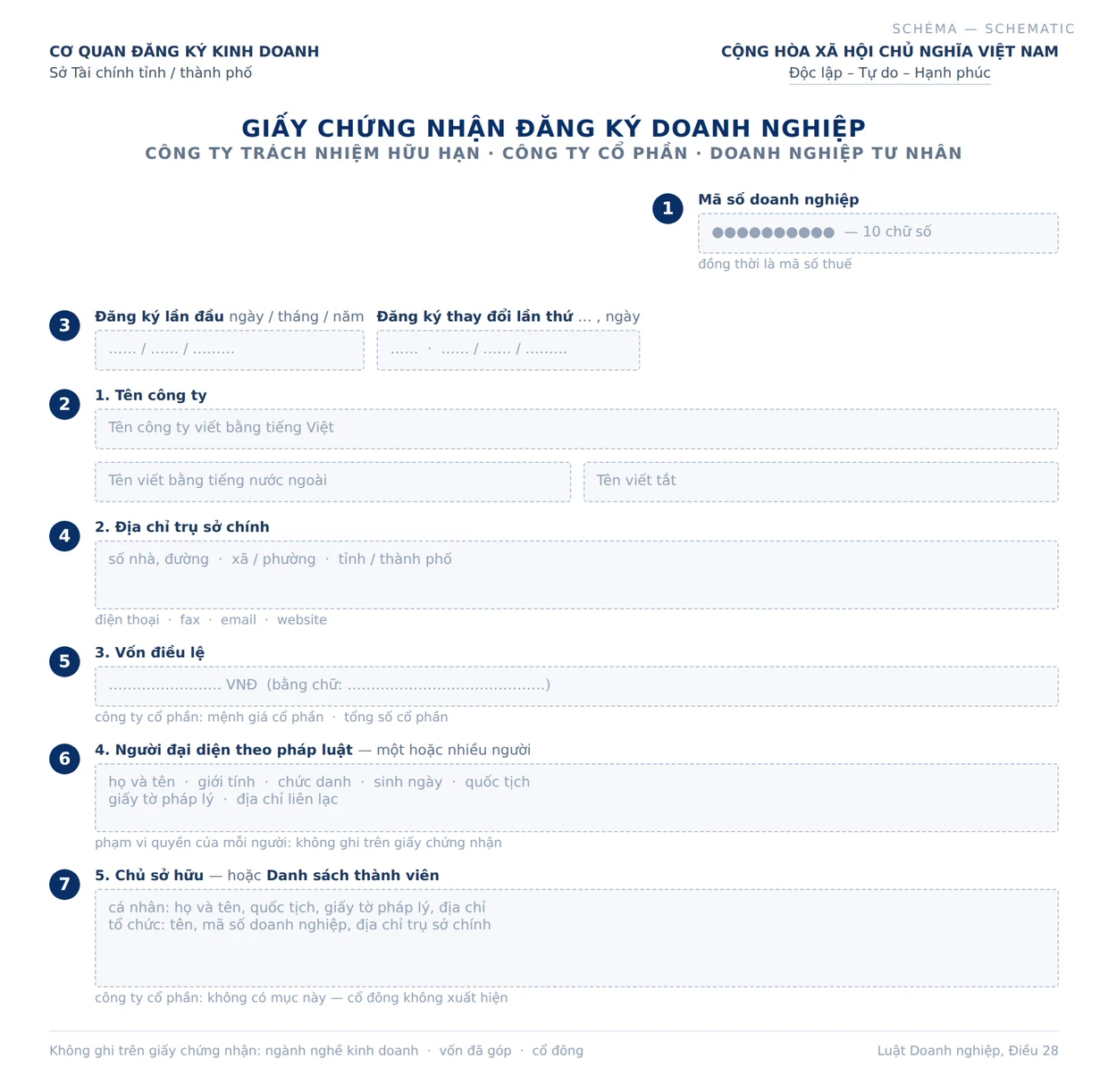
Four categories of particulars, set by article 28 of the Law on Enterprises, and nothing else. What is not on the list is not on the document — which is the source of most of the misunderstanding.
| On the certificate | What it is | What to check |
|---|---|---|
| 1 · Enterprise code Mã số doanh nghiệp | Ten digits, assigned once and kept for the life of the company. It is also the tax code, and the certificate also serves as the tax registration certificate. | That it is ten digits. Thirteen digits — ten, a dash, then 001 to 999 — is a branch or a representative office, whose first ten digits give the parent. |
| 2 · Company name Tên công ty | The Vietnamese name, and where they exist the foreign-language name and the abbreviation. | That the contract is in the Vietnamese name. The English name is a convenience, not the legal identity. |
| 3 · First registration, and amendment number Đăng ký lần đầu · đăng ký thay đổi lần thứ | The date of first registration, then the number and date of the latest amendment. | The amendment number. A company on its fourteenth amendment has a history; ask what changed and when. |
| 4 · Registered office Địa chỉ trụ sở chính | The address for service. Not necessarily a place of business. | Whether anything is actually there. A certificate issued before July 2025 names a district that no longer exists — see the box below. |
| 5 · Charter capital Vốn điều lệ | The capital the members have undertaken to contribute, in figures and in words. For a joint-stock company, also the par value and the total number of shares. | Nothing about payment. See the next section — this is the single most misread figure on the document. |
| 6 · Legal representative(s) Người đại diện theo pháp luật | Name, sex, title, date of birth, nationality, identity document, contact address. There may be more than one. | How many there are. The certificate names them but never says how their powers are divided. |
| 7 · Owner or members Chủ sở hữu · danh sách thành viên | The owner of a single-member limited company, or the list of members of a multi-member one — individuals and corporate bodies alike. | That it is there at all. A joint-stock company shows no shareholders on its certificate. That is the principal blind spot of the Vietnamese record. |
Three things a reader looks for and will not find. The business lines left the face of the certificate with the Law on Enterprises of 2014, in force 1 July 2015; they live in the national database instead. The paid-up capital appears nowhere. And the shareholders of a joint-stock company are not shown — only the legal representatives are.
Why are there three capital figures, and which one is real?
A foreign-invested company carries three different capital numbers across its two certificates, and a fourth that appears on neither. Confusing them is the most expensive mistake a foreign counterparty makes.
| The figure | Where it sits | What it means |
|---|---|---|
| Charter capital Vốn điều lệ | Enterprise certificate | What the members have undertaken to contribute. A promise, registered. |
| Total investment capital Tổng vốn đầu tư | Investment certificate | What the project is to cost in all — equity plus borrowings. Larger than the charter capital by design. |
| Investor’s contribution to the project Vốn góp thực hiện dự án | Investment certificate | The equity portion of the above. Still not the same as the charter capital. |
| Paid-up capital | Nowhere | What was actually received. It appears on no certificate and in no public register. |
The members have ninety days from the issue of the enterprise certificate to pay in what they subscribed (arts. 47, 75 and 113 of the Law on Enterprises). If they do not, the company must register the reduced capital within a further thirty days — a failure fined VND 30 to 50 million, about USD 1,150 to 1,900 at VND 26,110 to the dollar. So a certificate showing VND 100 billion of charter capital is consistent with three different worlds: the money is in, the ninety days have not expired, or the company is in breach. Only a bank statement on the capital account, or audited accounts, will tell you which.
And there is one real advantage in Vietnam: a foreign-invested company must have its annual financial statements audited, under article 37 of the Law on Independent Audit of 2011 and article 15 of Decree 17/2012. The accounts are not public — but they exist, they are audited, and a counterparty that will not produce them is telling you something.
How do you check the two registers?
Vietnam keeps two public lookups, free and separate. They answer different questions and they do not always agree — and it is the disagreement that is worth the search.
The private mirrors — masothue.com and the rest — are useful for one thing only: finding the enterprise code from an approximate name, which the official portals do badly. They are scraped copies with no refresh date and no legal value, and they do not carry the tax status at all. Never cite one in a report.
On 1 July 2025 Vietnam went from 63 provinces to 34 and abolished the district tier altogether, under National Assembly resolutions 202/2025/QH15 and 203/2025/QH15. Addresses are now written street, commune, province — with no district in between.
Companies were not required to update their certificates. Official letter 4370/BTC-DNTN of 5 April 2025 and article 57 of Decree 168/2025 say so expressly: the registration office may not require it, the update is free, and there is no deadline. So a certificate naming Bình Dương or Bà Rịa–Vũng Tàu is not out of date and not a forgery.
The tax authority, on the other hand, updated its own records automatically. A mismatch between the address on the certificate and the address on the e-invoices is therefore normal in 2026, and is not by itself a discrepancy worth raising.
Who can bind the company?
A limited liability company and a joint-stock company may each have more than one legal representative, in any number, since the Law on Enterprises of 2014. All of them are named on the certificate. None of their powers are.
Article 12(2) protects the third party where the charter is silent: if the division of powers between the representatives is not clearly set out in the charter, each of them is fully authorised as against a third party, and all are jointly liable to the company for the damage caused. The protection stops the moment the charter does divide those powers — and the charter is not public. There is no public register of it, and no way to obtain it from the authorities. Ask for a certified copy, and for the board resolution where the amount matters.
One legal representative must reside in Vietnam at all times. Where only one resident representative remains and he leaves the country, he must give a written mandate to someone resident in Vietnam; he stays liable for what the delegate does.
The company seal proves nothing any more. Since 1 January 2021 the company decides the form, the number and the content of its seals, notifies no one, and publishes no specimen — and a digital signature is itself a seal in law (art. 43). A seal created since 2021 cannot be verified through any public channel, and a contract signed by an authorised person without a seal is valid. What can be verified is the signatory, on the portal — and a digital signature, against the certification authority. The red stamp is the one piece of Vietnamese paperwork a European reader still over-trusts.
What will the register not tell you?
| What it does not show | Where the answer is, if anywhere |
|---|---|
| Who ultimately owns the company | Declared to the registry since 1 July 2025 — and expressly excluded from what a third party may obtain. Article 74 of Decree 168/2025 opens registration information to the public “except information on the beneficial owner”. Only the authorities may see it, for anti-money-laundering purposes. |
| The shareholders of a joint-stock company | Not on the certificate, not in the free portal. The register of shareholders is kept by the company; article 122 gives a right of inspection to shareholders only, and only over names and contact addresses. A third party has no route at all. |
| Whether a member holds for someone else | Nowhere. Nominee holdings have been expressly prohibited since 23 July 2026 — which makes them unlawful, not visible. |
| What the company may lawfully do | The business lines on the portal are a declaration, not a licence. For a conditional sector the company needs a separate sectoral permit, and for retail distribution a trading licence under Decree 09/2018 — replaced by Decree 342/2026 with effect from 18 October 2026. |
| What the company earns | Financial statements are filed with several authorities and published by none, for any unlisted company. For a listed one, they are on the Securities Commission’s disclosure system and the exchange. |
| What it owes | Nowhere in these documents. There is no register of charges to read across. |
One consequence deserves to be said plainly. The beneficial ownership regime was introduced by Law 76/2025/QH15 and tightened on 23 July 2026 by Decree 296/2026, which now requires the ownership chain to be traced layer by layer through foreign holding companies and trusts, aggregates family members and parties to an agreement who together reach 25 %, and — where no one qualifies — designates the manager with the widest powers, so that no company can declare none. It is a real regime. It is declared by the company, not verified by the registry, and no third party may read it.
Which signs should make you stop and ask?
| Sign | Why it matters |
|---|---|
| The tax register shows 06 — not at the registered address — while the business register still shows the company trading. | The tax authority went and found nobody. The company cannot issue compliant invoices; your input VAT is at risk and so is delivery. |
| The legal status reads “temporarily suspended”. | The company exists and keeps its debts but must not trade. Contracting with it during the suspension is a problem for both sides. Since 23 July 2026 the cumulative suspension is capped at twenty-four months. |
| The counterparty is a joint-stock company and you have been shown only the certificate. | The certificate of a joint-stock company shows no shareholder at all. You have been shown everything the document holds, and nothing about who owns it. |
| The charter capital is large and the company was incorporated less than ninety days ago. | Nothing has necessarily been paid in. Ask for the capital account statement, not for the certificate again. |
| The enterprise code on the invoice has thirteen digits. | You are dealing with a branch or a representative office. It has no separate legal personality; the parent, identified by the first ten digits, is the debtor. A representative office may not trade or invoice at all. |
| A foreign-invested company with no investment certificate, more than twelve months after incorporation. | Since March 2026 the certificate may come after incorporation, but not indefinitely. Past twelve months, ask what happened to the application. |
| The business lines on the portal include a conditional sector and no sectoral licence is produced. | Registration is declarative. The list of conditional sectors went from 227 to 198 on 1 July 2026 and to 142 under resolution 66.17/2026/NQ-CP; a sector leaving the list does not cure a licence that was never obtained. |
| A foreign-invested company that cannot produce audited accounts. | The audit is compulsory and has been since 2012. The fine for skipping it is VND 40 to 50 million — about USD 1,500 to 1,900 — which is not a deterrent. Its absence is a choice, not an oversight. |
| Several legal representatives, and no charter offered. | Article 12(2) protects you only while the charter is silent. You cannot know whether it is silent without reading it. |
| A red seal offered as proof that the document is genuine. | It proves nothing since 2021. Verify the signatory instead. |
How we help
We run both registers rather than one, we read the legal status against the tax status, and we say which of the two we would rely on. Where the answer only exists inside the company — the charter, the register of members, the capital account, the audited accounts, the beneficial ownership declaration — we put the request in writing, in the form the law provides, so that a refusal is on the record and dated. On formation, we keep the two certificates, the charter capital and the project capital consistent from the first filing, and we watch the ninety days rather than discover them afterwards. And because this area of Vietnamese law was rewritten three times between July 2025 and July 2026, we tell you which version of the rule applied on the day your document was issued.