

Hong Kong company formation
The ideal gateway to Asia — a fast, digital and tax-efficient jurisdiction for your regional base.
Planning your Hong Kong company?
Our team supports you at every step — feasibility study, structuring, incorporation and local compliance.
Introduce your project and get your quote Contact usLatest news — Hong Kong

What tax regime applies to Hong Kong companies?
Territorial system: only Hong Kong-sourced profits are taxed — 8.25% up to HK$2M, 16.5% beyond. No VAT, no tax on dividends or capital gains.
Work permits and visas: conditions to obtain them
Employment visas, investment visas and the conditions attached to each route for foreign executives and staff.

The re-domiciliation regime for foreign companies
Since 23 May 2025, foreign companies can transfer their seat to Hong Kong without creating a new legal entity — full legal continuity, no economic-substance test.
A stable, liberal and international environment

Hong Kong remains a strategic destination for foreign entrepreneurs and investors entering Asia. Operating under “one country, two systems”, the SAR keeps a legal and tax framework distinct from Mainland China: a common-law system inspired by British law, no exchange controls, and a stable, fully convertible currency (HKD).
Its tax system is one of the most competitive in the world and strictly territorial — only profits sourced in Hong Kong are taxable. There is no VAT, no tax on dividends or capital gains, and foreign-sourced income can qualify for offshore treatment in this OECD-compliant jurisdiction.
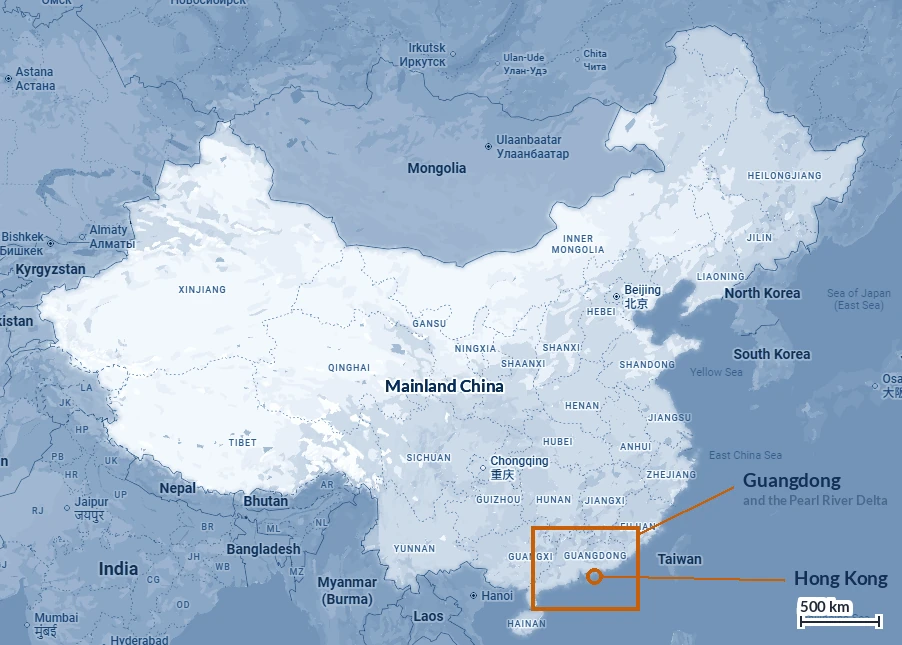
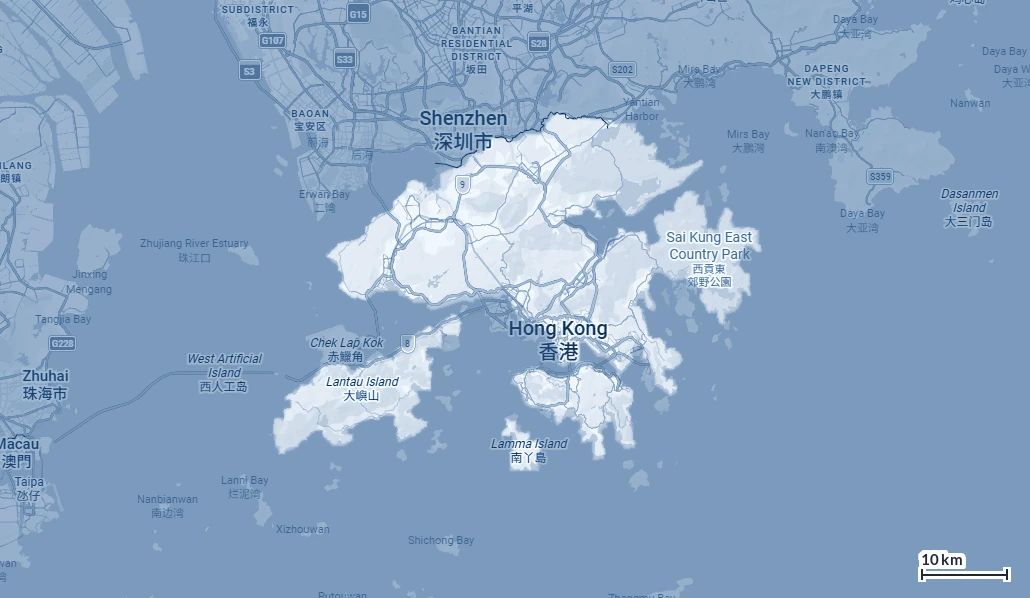
Located at the heart of Asia-Pacific, Hong Kong gives direct access to Mainland China (Shenzhen, Guangzhou and the Greater Bay Area via CEPA), to South-East Asia, and to the region’s main logistics and financial hubs. Incorporation is fast, digital and possible 100% remotely.
A free port that still needs agreements
Hong Kong charges no customs duty on anything. Its agreements are therefore not about what you pay to bring goods in — they are about what a Hong Kong company is entitled to abroad, and above all on the Mainland.
The agreement that does the work
Zero duty into the Mainland since 2006, and since March 2025 no waiting period before a new Hong Kong company can use it
The Closer Economic Partnership Arrangement was signed on 29 June 2003 and took effect on 1 January 2004 — the first free-trade agreement either side had ever concluded. It is not one document but a family: a main text, the Agreement on Trade in Goods of 2018, the Agreement on Trade in Services, the Investment Agreement, an economic and technical cooperation agreement, and a run of amendments. The most recent is the Second Amendment to the Agreement on Trade in Services, signed 9 October 2024 and in force since 1 March 2025.
On goods the rule is simple: since 1 January 2006, all goods of Hong Kong origin that meet the CEPA rules of origin enter the Mainland free of duty. On services the Mainland has opened 153 of the 160 WTO services sub-sectors to Hong Kong — a wider opening than it has granted any other economy.
Origin, and who certifies it
Wholly obtained in Hong Kong, made only from originating materials, or meeting the product-specific rule or the value-content test. The certificate is issued by the Trade and Industry Department or by one of five approved bodies; manufacturers must hold factory registration first. There is no self-certification under CEPA.
What it is worth in practice
Cumulative duty saved on Hong Kong-origin goods entering the Mainland had passed RMB 10.2 billion by the end of 2024. Nearly two thousand companies hold Hong Kong service-supplier status under the arrangement.
Hong Kong law, on Mainland contracts
The 2024 amendment also lets Hong Kong-invested enterprises on the Mainland choose Hong Kong law and Hong Kong-seated arbitration in their contracts — a structural point that usually matters more to a European parent than any tariff line.
Clearance in the Greater Bay Area
The single e-lock scheme covers more than a thousand routes across 56 crossing points, with mutual recognition of authorised economic operators. Guangdong Customs added twenty further facilitation measures in May 2026, including a single filing that serves both declarations.
Nine agreements, negotiated as a separate customs territory
Hong Kong is a WTO member in its own right and signs its own treaties
Because Hong Kong levies no import duty, none of these agreements lowers the cost of bringing goods in — there is nothing to lower. Their value runs the other way: preferential access for Hong Kong-origin exports, market-access and national-treatment commitments for Hong Kong service suppliers, and investment protection for Hong Kong companies operating abroad.
| Partner | Signed | In force | What it opens |
|---|---|---|---|
| Mainland China — CEPA | 29 Jun 2003 | 1 Jan 2004 | Zero duty on Hong Kong-origin goods; 153 services sub-sectors |
| New Zealand | 29 Mar 2010 | 1 Jan 2011 | Goods, services, investment |
| EFTA | 21 Jun 2011 | 1 Oct 2012 | Iceland, Liechtenstein, Switzerland — and Norway from 1 Nov 2012 |
| Chile | 7 Sep 2012 | 9 Oct 2014 | Goods and services |
| Macao | 27 Oct 2017 | 27 Oct 2017 | Liberalisation measures from 1 Jan 2018 |
| Georgia | 28 Jun 2018 | 13 Feb 2019 | Goods, services, investment |
| ASEAN | 12 Nov 2017 | staged from 11 Jun 2019 | Fully in force 12 Feb 2021, with a separate investment agreement |
| Australia | 26 Mar 2019 | 17 Jan 2020 | Goods, services, and an investment agreement of the same date |
| Peru | 15 Nov 2024 | 1 Sep 2026 | The newest of the nine. Peru opens the great majority of its tariff lines to Hong Kong goods |
Investment protection is uneven across Europe
Twenty-four investment promotion and protection agreements are in force, ten of them with European countries — Austria, the Belgium–Luxembourg union, Denmark, Finland, France, Germany, Italy, the Netherlands, Sweden, Switzerland — plus the United Kingdom, and Türkiye since February 2026. Spain, Portugal, Ireland and Poland are among those with none. Protection follows the parent’s jurisdiction, so it is worth checking before the holding structure is fixed.
A wide and still-growing tax treaty network
Close to sixty comprehensive double taxation agreements have been signed, of which the majority are in force. Norway signed in December 2025; Türkiye’s came into force in January 2026. Several signed in 2025 and 2026 are still awaiting entry into force — check the status of the specific treaty, not the headline count.
Substance is where the risk has moved
The Mainland applies a beneficial-owner test before granting the reduced 5 % withholding rate on dividends paid to a Hong Kong parent. Board decision-making, staff, premises and real operating expenditure in Hong Kong now decide the outcome — a holding company with one passive director and an obligation to pass income straight through is the textbook adverse case.
And at the Hong Kong end too
Hong Kong’s foreign-sourced income exemption carries its own economic substance test for multinational groups — lighter for pure equity holding, heavier where the entity holds other income. Outsourcing within the group is allowed, but it must be real and monitored.
Structures available to foreign investors
The Private Limited Company is the standard choice for foreign investors, but several forms exist depending on your project.
Private Limited Company (HK Ltd)
The standard vehicle for foreign investors
- Limited liability, single shareholder possible
- Credible with banks and partners worldwide
- Taxed only on Hong Kong-sourced profits
- Requires a local company secretary and registered office, annual audit
Offshore holding / trading company
International trade and asset structuring
- No tax on qualifying foreign-sourced income
- No withholding tax on dividends
- Multi-currency bank accounts
- Requires proper compliance in the shareholders’ country of residence
Sole Proprietorship
Small local activities
- Very light formalities and cost
- Simplified taxation
- Unlimited personal liability
- Not suited to growth or international trade
Partnership (General / Limited)
Specific local joint projects
- Two or more partners, natural or legal persons
- General: unlimited liability of partners
- Limited: passive partners’ liability can be capped
- Rarely used by foreign investors
Since 23 May 2025, the re-domiciliation regime also allows an existing foreign company to transfer its registered seat to Hong Kong under the Companies Ordinance (Cap. 622) — keeping its contracts, assets and legal identity, with no local liquidation and no economic-substance test.
Which structure fits your project?
Tell us in a guided questionnaire, saved in your browser as you go, and receive a fixed-fee quotation. No supporting document is asked for at this stage.
Introduce your project and get your quoteThe Bay Area, the company, the visa and the tax bill
What stays here and what goes north; what incorporation really involves once the certificate has issued within the hour; how a foreign professional obtains the visa that is also the work authorisation; and what is taxed here — along with the longer list of what is not. Each comes with a note you can download and circulate.
The delta supplies scale. Hong Kong supplies the envelope.
Common law, free capital movement, and an award enforceable in 170 countries
Seen from the north, Hong Kong is one of eleven cities in a bay economy. Seen from here it is something else: the one place in that bay where capital moves without permission, contracts are read under common law, and a dispute ends in an arbitral award enforceable across the world — with interim measures available in mainland courts in support of it, a feature no other seat has.
The four things Hong Kong holds
Holding, because ownership changes without a mainland filing. Treasury, because funding a subsidiary or receiving a dividend needs no approval. Intellectual property and international contracting. And dispute resolution.
Substance is the condition
The 5% rate depends on the Hong Kong company being more than a name on a certificate: its own directors deciding here, its own accounts, its own bank relationship, a commercial reason to exist. The mainland tax authority tests this.
Where the boundary is thinning
The Northern Metropolis reorients the territory towards Shenzhen, and the Hong Kong–Shenzhen Innovation and Technology Park in the Loop sits on the boundary itself — designed for teams operating on both sides of it.
Coming in without starting again
Since May 2025 a foreign company can re-domicile to Hong Kong, keeping its legal identity, contracts and history, with no economic-substance test. For a group with an awkwardly placed holding company, it is the shortest route to a workable structure.
The private company limited by shares, step by step
Incorporated within the hour — and regulated by deadlines that begin the moment it exists
Hong Kong incorporates faster than almost anywhere. That speed is real, and it is also the source of the commonest mistake we see: nothing binds the Registrar to any time limit — the hour is a service pledge, not a statute — while several obligations on the company itself start at incorporation, with no grace period.
Two dates decided at the first board meeting
The first accounting reference period may run up to eighteen months. A 31 December or 31 March year end aligns with the Inland Revenue’s block extension scheme; an odd date forfeits it. Decided once, and awkward to change afterwards.
Notify chargeability yourself
If the company is chargeable to profits tax and no return has arrived, it must say so within four months of the end of the basis period. The Department does not have to ask first, and a first year is exactly when this is missed.
The bank is the project, not the Registrar
Six to twelve weeks is normal, a decline is not a rarity, and the simplified account now offered by some banks is presently closed to companies with foreign shareholders — that is, to the companies that would most use it.
The levy is back
The business registration levy of HK$150 was restored on 1 April 2026, with no waiver for 2026-27. The registration fee itself is set in the Budget each February and has moved twice in three years; we quote it at the date of the engagement.
Here, the visa is the work permit
One document instead of four — but the employer is examined as closely as the candidate
Hong Kong issues no separate work permit: permission to work is a condition of stay written into the visa, and it is tied to a named employer and a named post. That single design choice explains the rest — a short file, a four-week decision, and the need to go back to the Immigration Department when the employer changes. One route escapes it: the Top Talent Pass, granted on time limitation only.
Four ways in
The General Employment Policy for a confirmed offer; the Top Talent Pass, which needs no offer at all; the Quality Migrant Admission Scheme for those settling without a sponsor; and the Mainland talents scheme for residents of the Mainland.
The Top Talent Pass, precisely
HK$2.5 million of income in the past year gives 36 months; a degree from an eligible university plus three years’ experience gives 24; a recent graduate from one gives 24 under quota. The first term is free of any employment condition — the extension is not.
Where a young company’s file fails
Not on the candidate. A company with no accounts, no lease and no local staff is asked why the post exists. The answer is documentary, and a visa filed in the same week as the incorporation is the commonest avoidable refusal we see.
What the employer owes
No payroll withholding and no social security in the continental sense: MPF at 5% each on a capped base, compulsory employees’ compensation insurance, and the Employment Ordinance minima. Newcomers on a stay of thirteen months or less are exempt from MPF.
Three schedules, and what is simply not levied
No VAT, no capital gains tax, no dividend withholding — and, since 2025, a 15 % floor for large groups
Hong Kong has no general income tax. It has three schedules — profits tax, salaries tax, property tax — and income falling into none of them is not taxed, even when it arises here. That structural fact explains more than any rate does. What changed, and changed sharply, is the position of large groups.
The €750m question comes first
Above that consolidated revenue, the Hong Kong minimum top-up tax lifts an effective 11 % back to 15 %. The two-tiered rate, the concessionary regimes and much of the offshore claim are economically neutralised — and remain fully valuable below the line.
One election per group
Among connected entities only one may take the two-tiered rates in a given year. The saving is capped at HK$165,000 for the whole group, and it is worth deciding deliberately which company takes it.
Certainty on disposal gains
Since 1 January 2024 a safe harbour secures the capital treatment of gains on equity held at 15 % or more for at least 24 months — the first real certainty Hong Kong has offered a holding company.
Two calculations, the lower one wins
Salaries tax is computed on the progressive scale with allowances, and again at the standard rate on a wider base without them. The Revenue applies whichever is lower. For a married couple with two children the standard rate only bites above about HK$5.7m.
Briefing notes on Hong Kong
Every note is dated and written against the texts in force. Read it online, or download it as a PDF from its page.
- Establishing a New Co. in Hong KongBriefing note No.2 · 29/08/2026 · Incorporating a private company limited by shares in Hong Kong: requirements, documents, the NNC1 procedure, the bank account and the first-year deadlines.
- Working in Hong KongBriefing note No.5 · 28/08/2026 · Working in Hong Kong as a foreigner: employment visa, Top Talent Pass, QMAS, dependants, extensions, and what the employer owes in MPF and insurance.
- Taxation in Hong KongBriefing note No.8 · 29/08/2026 · Taxation in Hong Kong: profits tax at 8.25% and 16.5%, the territorial principle, no VAT or capital gains tax, salaries tax and the 15% minimum tax.
- Hong Kong and the Greater Bay AreaBriefing note No.11 · 28/08/2026 · Hong Kong in the Greater Bay Area: holding, treasury, IP and dispute resolution, the 5% dividend rate from the Mainland, and the substance it requires.
- Hong Kong's trade agreementsBriefing note No.17 · 01/09/2026 · Hong Kong's trade agreements: CEPA with the Mainland, nine free trade agreements, investment treaties and the substance behind certificates of origin.
- Re-domiciling a company to Hong KongBriefing note No.28 · 09/10/2026 · Re-domiciling a foreign company to Hong Kong since May 2025: eligibility, the NNC6 procedure and fees, tax treatment and the effect on subsidiaries.
- Verifying a Hong Kong companyBriefing note No.22 · 14/09/2026 · How to verify a Hong Kong company: what the certificate of incorporation and business registration certificate prove, register searches and warning signs.