

Verifying a Hong Kong company
What the certificate of incorporation and the business registration certificate each prove, how to test them against the registers, and what neither can tell you
Download this note as a PDF Version française (PDF)
Ask a Hong Kong counterparty for its company documents and two certificates come back. One is permanent, holds four lines, and is never reissued; the other expires every year and holds nine. Neither is issued by the same authority, neither proves what it is usually taken to prove, and the gap between them is where most of the trouble sits. This note sets out what each document records, how to test it against the register behind it, and the questions that only a search will answer.
Two documents, two registries
Hong Kong keeps the existence of a company and the registration of its business in two separate places. The Companies Registry brings the legal person into being under the Companies Ordinance (Cap. 622) and issues the certificate of incorporation. The Business Registration Office of the Inland Revenue Department registers the business for tax purposes under the Business Registration Ordinance (Cap. 310) and issues the business registration certificate. Since 21 February 2011 a single application produces both at once — the one-stop company and business registration service — but they remain two instruments, from two authorities, proving two different things.
| Certificate of incorporation | Business registration certificate | |
|---|---|---|
| Issued by | Companies Registry | Inland Revenue Department |
| Under | Companies Ordinance, Cap. 622 | Business Registration Ordinance, Cap. 310 |
| What it evidences | That a legal person came into existence on a stated day, under a stated name | That a business has been registered with the tax authority and the fee paid for a stated period |
| How long it lasts | For the life of the company. It is never renewed and never reissued | One year, or three at the company’s election. It expires on the date it carries |
| What it costs | Included in the incorporation fee. A certified copy is HK$130 — about USD 17 | HK$2,350 a year, or HK$6,170 for three years — about USD 300 and USD 790 |
| Branches | No concept of a branch | Each branch carries its own certificate, at HK$230 a year |
A certificate issued electronically has the same legal effect as one on paper (Cap. 310, s. 6(3B)). Since a genuine certificate is now routinely a PDF, a PDF proves nothing on its own: there is no signature, no hash and no verification page to check it against. What proves it is the register.
What does the certificate of incorporation record?
Four things, and nothing else. It is a short document, and its shortness is the point: it fixes the moment a legal person was created, and it is never amended afterwards.
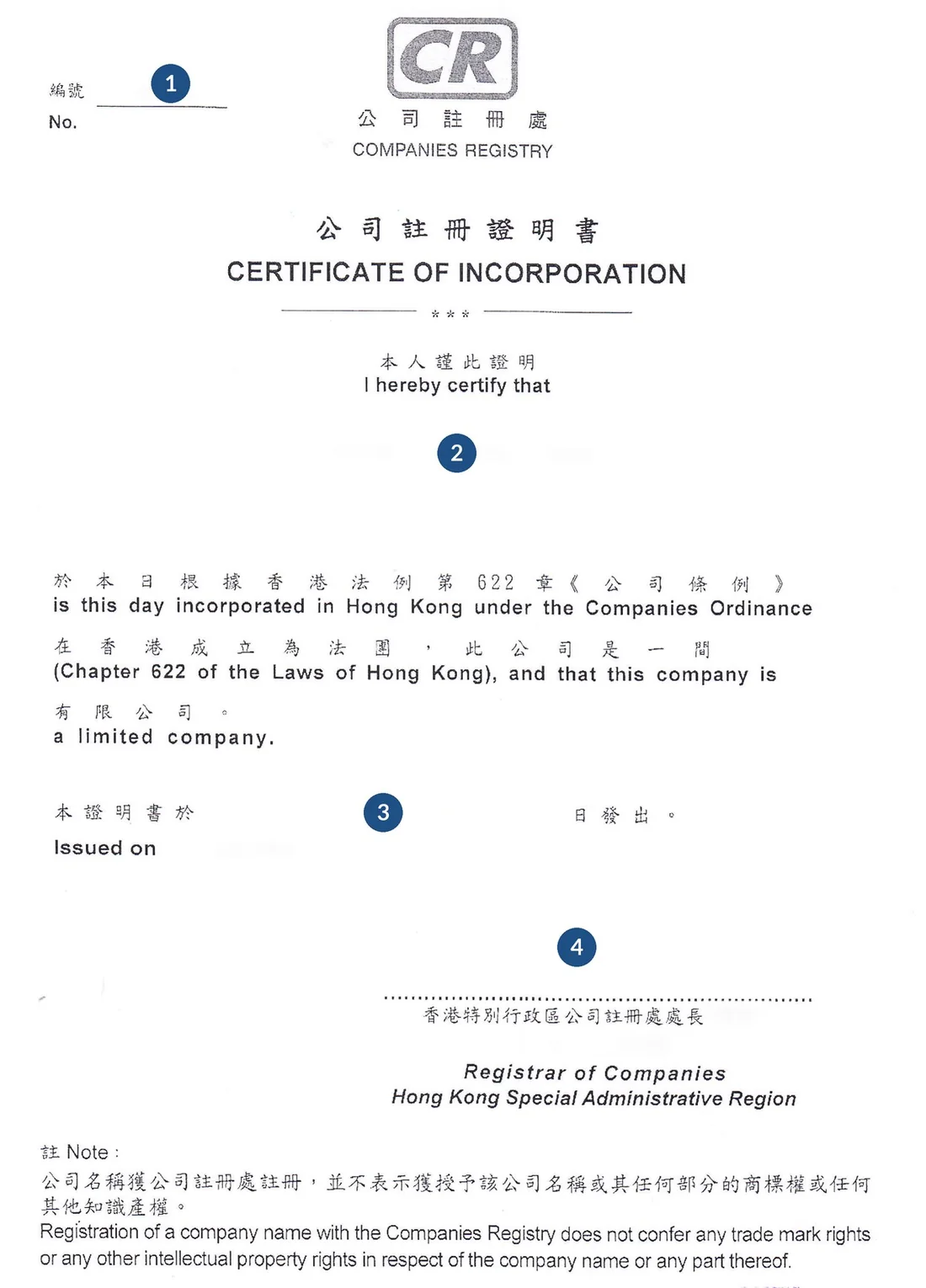
| On the certificate | What it is | What to check |
|---|---|---|
| 1 · Number | The company’s identifier. For a company incorporated on or after 27 December 2023 this is the eight-digit business registration number itself. | That it matches the first eight digits of the business registration certificate — for a company formed since that date. For an older one, it will not match, and that is normal. |
| 2 · Name | The name registered on the day of incorporation, in English, in Chinese, or in both. | That it is the name on the contract. If it is not, ask for the certificate of change of name — see the next paragraph. |
| 3 · Date of issue | The day the company came into existence. | That it fits the track record you were given. It is the only date on the document, and it never moves. |
| 4 · Registrar’s signature | The signature of the Registrar of Companies in office on that day. | Nothing. It authenticates nothing that a search will not tell you better. |
A company that changes its name keeps the certificate it was given on the first day: the Registrar issues a separate certificate of change of name, and does not reissue the original. A certificate of incorporation in a name the company no longer uses is therefore the ordinary case, not a discrepancy — but the change has to be evidenced, and the only complete record of it is the register.
What does the business registration certificate record?
Nine particulars on a single A4 sheet, printed in English and Chinese, under the heading Form 2. The upper part of the sheet is the payment advice and the lower part the certificate proper; a dotted line invites the holder to cut between them. A certificate presented as a whole uncut sheet is normal.
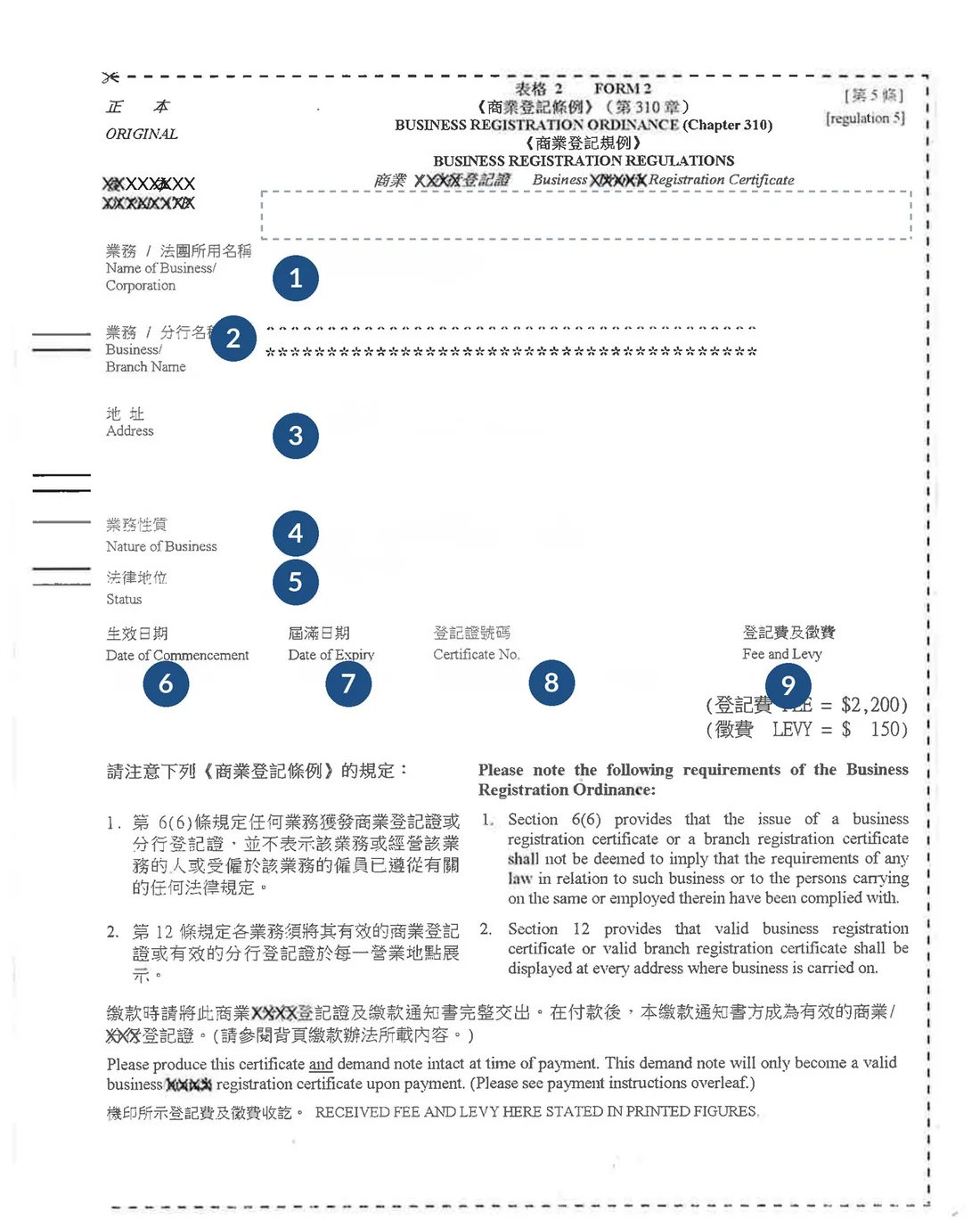
| On the certificate | What it is | What to check |
|---|---|---|
| 1 · Name of business / corporation 業務/法團所用名稱 | The legal name — for a company, the name on the certificate of incorporation as it stands today. | That it is the party to the contract. For a sole proprietorship, the legal person is the individual, not the business. |
| 2 · Business / branch name 業務/分行名稱 | The trading name, where there is one. Where there is none the field is filled with rows of asterisks, not left blank. | That the contract, the invoices and the bank mandate are in the name at line 1, not in this one. |
| 3 · Address 地址 | The registered business address, declared by the company and notifiable within one month of any change. | That it is an address the company actually occupies, and not only a secretarial service address. |
| 4 · Nature of business 業務性質 | A self-declared descriptor, used for tax classification. | Nothing binding: it is not a limitation on what the company may do, and it evidences no licence or permit. |
| 5 · Status 法律地位 | Body corporate, sole proprietorship, partnership, branch of a non-Hong Kong company. | That it is the form you were told. A sole proprietorship carries no limited liability. |
| 6 · Date of commencement 生效日期 | The first day of the period covered by this certificate. | Together with line 7, the period: one year or three. |
| 7 · Date of expiry 屆滿日期 | The last day of that period. After it, the certificate is not valid. | That the date has not passed. A three-year span is lawful and not a sign of forgery. |
| 8 · Certificate number 登記證號碼 | Eight digits — the business registration number — then a three-digit branch code, then further segments. | That the branch code reads 000. A code of 001 or above is a branch, not the principal registration. |
| 9 · Fee and levy 登記費及徵費 | What was paid for the period, determined by the date of commencement rather than the date of payment. | That the figure matches the official rate for that year. A machine-printed payment line must also appear at the foot. |
A certificate showing no fee is not necessarily false. A business whose average monthly turnover does not exceed HK$10,000 for services, or HK$30,000 otherwise — about USD 1,280 and USD 3,850 at HK$7.80 to the dollar — may obtain an exempt certificate, renewable yearly. The exemption is itself information: it places the counterparty below those thresholds.
Hong Kong abolished the separate company number. Under the Unique Business Identifier reform, the eight-digit business registration number became the company’s single identifier, and it is now printed as the number on the certificate of incorporation. For any company incorporated on or after 27 December 2023, the two documents carry the same eight digits.
For a company incorporated before that date, they do not, and no fresh certificate was issued. The Companies Registry publishes mapping lists between the former company number and the current identifier, and will sell a letter of confirmation for HK$130 — about USD 17. A mismatch on an older company is therefore expected; a mismatch on a recent one is not.
One number should stop you outright: an identifier beginning with a letter, such as C0012345. That is a dummy number assigned during the migration to an entity that has no business registration record at all with the Inland Revenue Department.
How do you check them against the registers?
There is no single Hong Kong lookup that authenticates either certificate. Two searches are needed, at two authorities, and they do not serve each other’s documents.
What do the two certificates not tell you?
| What they do not show | Where the answer is |
|---|---|
| Whether the company is still live | The status on the Companies Registry search. The certificate of incorporation survives dissolution. |
| Who owns and who runs the company | The Companies Registry: shareholders of record, directors, company secretary. Beneficial ownership is kept in the company’s own significant controllers register, open to law enforcement and not to the public. |
| What the company may lawfully do | The sectoral regulator. Nothing on either certificate evidences a licence from the Securities and Futures Commission, the Monetary Authority, the Insurance Authority or any other body. |
| Whether it is financially sound | Nowhere in these two documents. A private Hong Kong company files no public accounts. |
| Whether the person you deal with may bind it | The directors named at the Companies Registry, or a written authority from the company. Neither certificate names a single officer. |
| Whether the address is a place of business | Only an inspection, or the pattern of other companies registered at the same address. |
Which signs should make you stop and ask?
| Sign | Why it matters |
|---|---|
| The date of expiry has passed. | The certificate is not valid. Expired copies circulate constantly in data rooms — ask for the current one and verify by extract. |
| The branch code is 001 or above. | You have been given a branch certificate where the principal registration was asked for. |
| The number on the certificate of incorporation and the first eight digits of the business registration number differ, on a company formed since 27 December 2023. | One of the two documents is not what it appears to be. |
| The identifier begins with a letter. | A dummy number: the entity has no business registration record with the Inland Revenue Department. |
| There is no machine-printed payment line at the foot. | The fee has not been shown as paid, and the document is not a valid certificate. |
| The fee shown does not match the official rate for the year of commencement. | The figure has been altered, or the certificate belongs to another period. The levy of HK$150 was suspended from 1 April 2024 and resumed on 1 April 2026. |
| The contract is in the trading name at line 2 rather than the legal name at line 1. | The party you have contracted with may not be the legal person you think. |
| The certificate of incorporation is in a different name from the business registration certificate. | Usually a change of name, which is ordinary — but it has to be evidenced by the certificate of change of name and by the register. |
| Only a certified copy is offered, and the register search is refused. | A certified copy attests the copy, not the facts. The reluctance is information in itself. |
How we help
We do not read the certificates and stop there. We search both registers, we order the certified extract when the history of the counterparty matters, and we tell you plainly which of your questions the Hong Kong registers can answer and which they cannot. Where a company is being formed, we set the file up so that the name on the contract, the name on the certificate and the name on the bank mandate are the same from the first day — which is the discrepancy that starts most enquiries. And we keep the business registration on its renewal cycle, with the three-year election where it earns its cost, so that the certificate a client sends to a counterparty is never the expired one.