

Hong Kong and the Greater Bay Area
What stays here, what goes north — the complementarity seen from Hong Kong
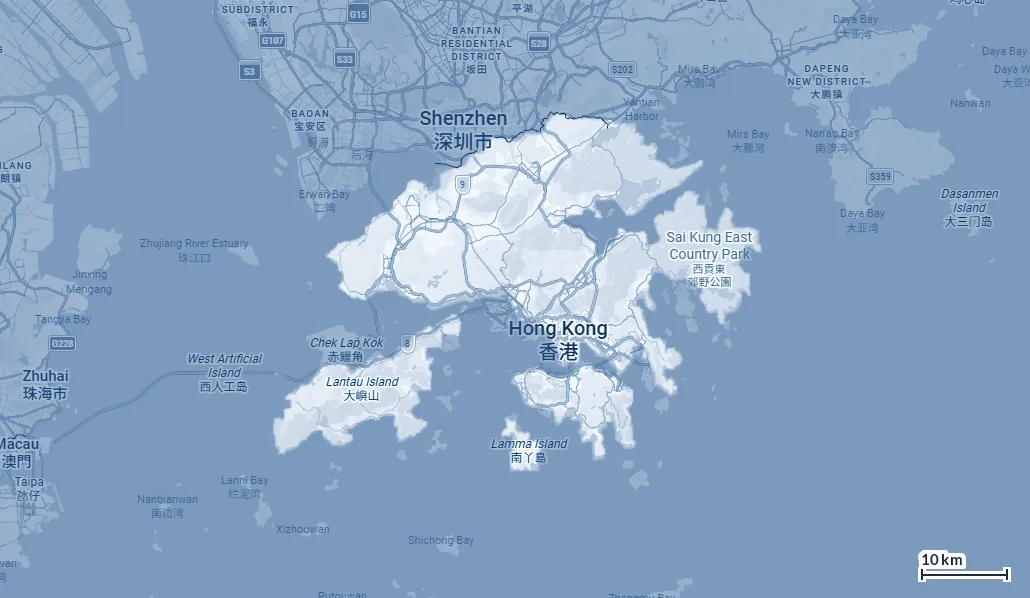
Seen from the north, Hong Kong is one of eleven cities in a bay economy. Seen from here, it is something else: the one place in that bay where capital moves without permission, contracts are read under common law, and a dispute ends in an award enforceable in 170 countries. The delta supplies scale. Hong Kong supplies the legal and financial envelope that makes the scale investable.
The four things Hong Kong actually holds
| Function | Why it sits here rather than north of the boundary |
|---|---|
| Holding | No exchange control, no restriction on shareholding structure, share transfers effected privately. A change of ownership upstream does not require a mainland filing at the level of the group. |
| Treasury | Multi-currency accounts as a matter of course, free inward and outward movement, no approval needed to fund a subsidiary or to receive a dividend. The renminbi is convertible here. |
| Intellectual property and contracting | Common law, an independent judiciary, and licensing arrangements that a foreign counterparty can read. Cross-border licences are usually written under Hong Kong law and priced from here. |
| Dispute resolution | An established arbitration seat, awards enforceable under the New York Convention, and interim measures available in mainland courts in support of Hong Kong arbitration — a feature no other seat has. |
The tax mechanics of the pair
Hong Kong taxes profits on a territorial basis: only Hong Kong-sourced profits are chargeable, at 8.25% on the first HK$2 million and 16.5% above. There is no VAT, no tax on dividends received and no capital gains tax. Under the double tax arrangement with the mainland, dividend withholding on a distribution from a mainland subsidiary falls to 5% where the Hong Kong company holds at least 25%, subject to satisfying the beneficial-ownership and substance requirements.
The 5% rate, and the treaty generally, depend on the Hong Kong company being more than a name on a certificate: its own directors taking decisions here, its own accounts, its own bank relationship, and a commercial reason to exist. The mainland tax authority tests this. A holding company built for the rate alone tends to fail exactly when it is needed.
What is genuinely easier from this side
Speed and reversibility
A private company is incorporated here in days, with one director and one shareholder, of any nationality, and no minimum capital. If a project changes shape, the Hong Kong layer adapts without a licence amendment. The mainland layer does not — which is a reason to settle the structure here first and register north second.
Coming in without starting again
Since 23 May 2025 a foreign company can re-domicile to Hong Kong: it becomes Hong Kong incorporated while keeping its legal identity, its contracts and its history. There is no economic-substance test. For a group already operating in Asia through an awkwardly placed holding company, this is now the shortest route to a workable structure.
Where the boundary is thinning
Two developments matter to anyone deciding what to keep here.
The Northern Metropolis reorients the territory towards the boundary: the districts facing Shenzhen are being planned as the innovation and technology axis of Hong Kong, rather than as a hinterland. Within it, the Hong Kong–Shenzhen Innovation and Technology Park in the Loop sits on the boundary itself and is designed for teams operating on both sides of it — the physical expression of the complementarity this note describes.
Talent admission has been widened over recent years — general employment visas, admission schemes for graduates of qualifying universities, and the arrangements for mainland and overseas professionals. For a foreign group this changes the practical answer to “where do we put the regional team”: Hong Kong is no longer only where the money sits.
Company service providers are licensed and supervised, with client due diligence documented before an engagement starts; significant controllers are recorded in a register kept at the company's own office; and banks apply substance expectations at account opening that a shelf structure will not meet. None of this makes Hong Kong harder to use — it makes it slower to use badly.
Reading the two notes together
The companion note, The Pearl River Delta, sets out the mainland side: which city does what, the cooperation zones, the five-year capital rule, beneficial ownership filing and document certification. The division of labour it describes is the same one seen from the other end.
| Question | Hong Kong | Mainland delta |
|---|---|---|
| Who owns the group | Holding company | — |
| Who employs the factory staff | — | Operating company |
| Who signs the international contracts | Hong Kong entity, Hong Kong law | Domestic contracts under PRC law |
| Where the cash pools | Multi-currency, unrestricted | Administered capital account |
| Who owns the intellectual property | Usually here, licensed north | Licensee |
| Where a dispute is decided | Arbitration, enforceable in the mainland | PRC courts for domestic matters |
We incorporate and administer the Hong Kong company — formation, company secretary, registered office, significant controllers register, annual return and audit coordination — and we build it as one half of a structure rather than as an isolated shell. Where the other half is a WFOE or a foreign-invested trading company in the delta, we run both files together so that the capital route, the document certification and the beneficial-ownership filings stay consistent from the outset. And where the right answer turns out to be Hong Kong alone, or Vietnam rather than the mainland, we say so before the incorporation rather than after it.