

Đồng Nai
Foreign direct investment in Vietnam’s first industrial basin
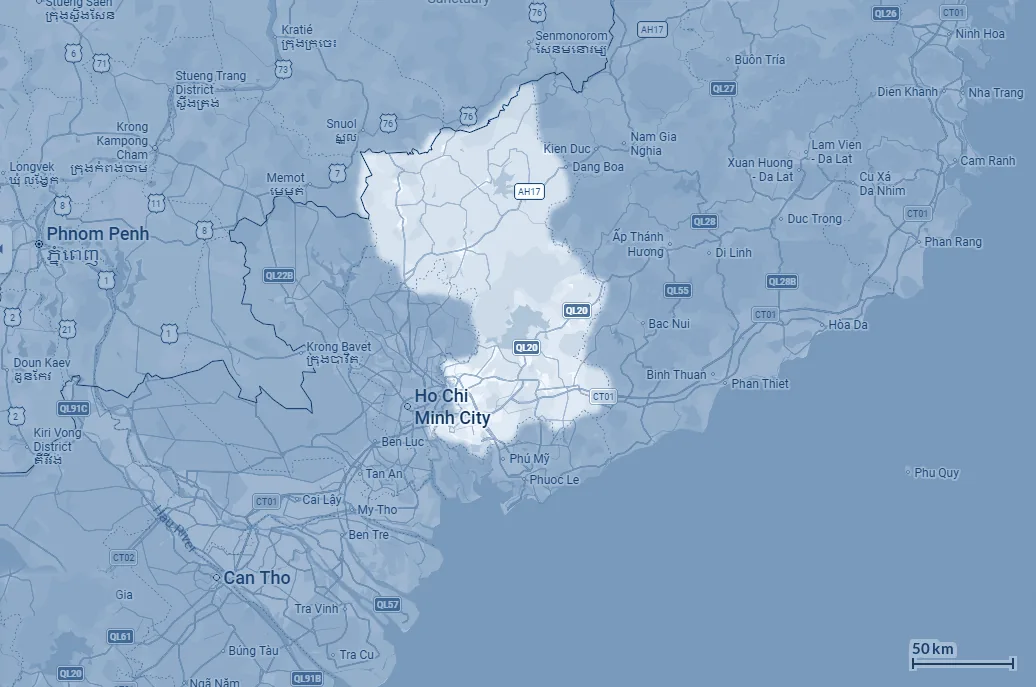
Đồng Nai changed status twice in under a year: merged with the former province of Bình Phước on 1 July 2025, then raised to the rank of centrally-run municipality on 30 April 2026 — the country’s seventh. For an investor the substance has not moved: this is still the industrial heart of southern Vietnam, half an hour east of Ho Chi Minh City, and now the site of the country’s new international airport.
What changed, and why it matters to a filing
Two reforms landed in quick succession, and both touch the paperwork of an incorporation rather than the economics of one.
| Date | What happened |
|---|---|
| 1 July 2025 | Đồng Nai and Bình Phước merge into a single entity keeping the name Đồng Nai — 12,737 km², 95 base-level units. The same day, nationwide, the district tier is abolished: administration runs on two levels, province and commune. |
| 30 April 2026 | Đồng Nai becomes a centrally-run municipality (thành phố trực thuộc trung ương), the seventh after Hà Nội, Ho Chi Minh City, Hải Phòng, Đà Nẵng, Huế and Cần Thơ. The commune split moves to 33 urban and 62 rural communes. |
Addresses, competent authorities and the wording of registration documents changed with the reform. A lease, a company extract or a licence issued before July 2025 may name a district that no longer exists. When we prepare a file we restate the address in the current two-tier form — province (municipality) and commune — and check that the landlord’s own title documents have been brought into line. This is the single most common cause of a returned file in the region today.
The industrial base
Of those projects, 1,918 are foreign-invested and 835 are domestic. Exports reached roughly USD 28.8 billion in 2025, up 18.9% on the year, against USD 20.1 billion of imports; the United States takes about a third of the exports, ahead of Japan, South Korea and China.
Where the industry sits
| Zone or cluster | Location | Occupancy | Character |
|---|---|---|---|
| Biên Hòa I & II | Trấn Biên / Long Bình Tân | Near saturation | The historic zones, opened 1963 — Nestlé, Ajinomoto, Cargill, Hisamitsu, Mabuchi |
| Amata | Trấn Biên | 100% | 513 ha, Sonadezi–Amata joint venture; Japanese, Thai and European investors |
| Nhơn Trạch I–VI, Ông Kèo | Nhơn Trạch | 85–90% | The densest pole: nine zones, 621 projects, 447 of them foreign |
| Lộc An–Bình Sơn / Long Thành | Long Thành | Developing | 497 ha beside the new airport — Bosch, Olympus, Ajinomoto |
| Bàu Xéo / Giang Điền / Sông Mây | Trảng Bom / An Viễn | 70–90% | Roughly 1,000 ha combined; the relocation basin for plants moving out of the city |
| Tân Phú | Tân Phú commune | High | 54 ha; Chang Shin Vietnam, around 17,000 jobs |
The dominant sectors are electronics and components; textiles, garments and footwear; mechanical engineering and automotive parts; wood and furniture; food processing; chemicals, pharmaceuticals and construction materials; and — growing fast with the airport — logistics. High technology, R&D and clean energy are the priority segment in the master plan.
The former Bình Phước half of the territory is a different economy: about three quarters of its active population worked in agriculture before the merger. It is Vietnam’s leading rubber-producing region, with a tradition going back to 1892, and the undisputed national centre for cashew — around 150,000 hectares, close to half the national area, and the country’s only protected geographical indication for the product. Fifteen approved industrial zones sit there, occupancy averaging some 68%, alongside active border trade through the Hoa Lư international gate to Cambodia.
Infrastructure — what is actually arriving
Long Thành international airport
Phase 1 works were to be completed in September 2026, with commercial operation targeted for the fourth quarter. Capacity is 25 million passengers a year in phase 1, up to 100 million over three phases, for a total investment of roughly USD 14 billion. It sits in the urban commune of Long Thành, about 40 km east of Ho Chi Minh City, and is designed to absorb all international routes over 1,000 km plus part of the domestic traffic currently concentrated at Tân Sơn Nhất.
Roads, rail, ports
- Expressways. Widening of Ho Chi Minh City–Long Thành–Dầu Giây to 8–10 lanes; Biên Hòa–Vũng Tàu; Bến Lức–Long Thành; ring roads 3 and 4; provincial road 25C linking the airport to ring road 3.
- Rail and mass transit. The north–south high-speed line, with an underground station inside the airport perimeter; the Thủ Thiêm–Long Thành metro; the extension of Ho Chi Minh City metro line 1 to Đồng Nai’s administrative centre and the airport. Most of these are not expected before 2030; rapid bus lines are the interim answer.
- Ports. Phước An port and river quays along the Đồng Nai; and, close by via Biên Hòa–Vũng Tàu, the deep-water complex of Cái Mép–Thị Vải.
The master plan, in one page
The 2021–2030 plan with a 2050 horizon, approved in July 2024 and adjusted after the merger in February 2026, rests on three pillars: exploiting Long Thành airport on an “aerotropolis” model; a break in transport infrastructure with priority to transit-oriented development; and three target industries — aerospace; semiconductors, chip fabrication and artificial intelligence; automation and IT equipment. Spatially the territory is read as five functional zones: south-west for innovation and aerospace, north-west (the former Bình Phước) as an agricultural trade gateway and cross-border logistics platform, north-east for high-technology agriculture and ecotourism, a protected natural and leisure zone around Trị An lake and Cát Tiên national park, and south-east around the urban pole of Long Khánh.
What this means when you set up
Choosing the address
Inside an industrial zone the management board handles part of the process and the premises evidence is straightforward. Outside one, the registered office must sit in premises with a commercial function — a residential apartment is excluded — and where you take a sublease the file has to show the head lease, the landlord’s right to sublet and the building’s fire-safety compliance.
Sequence and capital
A foreign-invested company is licensed twice: the Investment Registration Certificate first, then the Enterprise Registration Certificate. Charter capital must be paid in within ninety days of the second certificate, through the direct investment capital account. Missing that window means amending the registered capital, not simply paying late.
Lo On Shing has no registered establishment in Vietnam. Our anchor in the municipality is a strategic partnership with Giang Nam 3V Law Firm, whose office is at Trảng Bom, at the centre of the Giang Điền / Bàu Xéo industrial basin. Vietnamese-law filings, court and administrative dealings run through that partnership; structuring, the Hong Kong holding layer and the group’s compliance stay with us. No international firm has a physical office in the municipality — the practical service to investors is delivered by local firms, and the choice of that local partner is the variable that decides how a file actually moves.