

Establishing a New Co. in Vietnam
The foreign-owned limited liability company — under a framework rebuilt between 2025 and 2026
Vietnam has replaced most of the law governing this subject in eighteen months. The Law on Enterprises was amended with effect from 1 July 2025, a new Law on Investment took effect on 1 March 2026, business registration was recast by decree in 2025 and amended again in 2026, the capital account rules were reissued in August 2026, and the licence tax was abolished on 1 January 2026. Any note on Vietnamese incorporation written before mid-2026 is now wrong in several places. This one is written against the texts in force in August 2026, and it says where they are new.
Two certificates, and a choice that is new
A foreign-owned company in Vietnam has historically needed two instruments in a fixed order: the investment registration certificate (IRC), which authorises the foreign investment project, and then the enterprise registration certificate (ERC), which creates the company. Under the framework now in force it is also possible to take the ERC first and obtain the IRC within twelve months — useful where the company must exist before the project is fully defined, and a genuine change from the position most published guides still describe.
| Instrument | What it does | Time limit |
|---|---|---|
| IRC Investment registration certificate | Authorises the project: sector, location, capital, duration. Issued by the provincial authority; projects in an industrial zone go to the zone’s management board. | 10 working days from a valid dossier, where no in-principle approval is required |
| ERC Enterprise registration certificate | Creates the company and carries its tax code. There is no separate tax registration to make afterwards. | 3 working days from a valid dossier |
| Sub-licences | Required for conditional sectors — trading and distribution, education, logistics, food, and others. Each has its own authority and its own clock. | Sector by sector; the long pole in a retail or education project |
The Law on Enterprises was amended by Law 76/2025/QH15 with effect from 1 July 2025. The new Law on Investment, Law 143/2025/QH15, came into force on 1 March 2026, with Decree 96/2026/ND-CP implementing it. Business registration is governed by Decree 168/2025/ND-CP, itself amended by Decree 296/2026/ND-CP. Foreign direct investment capital accounts were reissued by Circular 38/2026/TT-NHNN of 18 August 2026. The licence tax (lệ phí môn bài) was abolished with effect from 1 January 2026. Work permits were recast by Decree 219/2025/ND-CP.
On top of that, the 2025 reorganisation of ministries moved competences between bodies. A procedure that was correct in 2024 may today be correct in substance and wrong in the authority it names — which is enough to have a dossier returned.
Minimum requirements
| 1 | One member is enough — a single-member LLC is the ordinary vehicle for a wholly foreign-owned business. Up to fifty members in a multi-member LLC. |
| 2 | A legal representative, who must reside in Vietnam. If there is only one, and that person leaves the country, an authorised substitute must be appointed in writing. |
| 3 | A registered office in Vietnam, with a lease and evidence that the premises may lawfully be used for the activity — residential apartments generally may not. |
| 4 | Charter capital sized to the project. No general minimum, but the amount must be credible against the stated activity, and some conditional sectors set their own floor. |
| 5 | Business lines drawn from the VSIC classification, and checked against Vietnam’s WTO commitments and the conditional-sector lists. |
| 6 | A direct investment capital account at a licensed bank — capital may not lawfully be contributed any other way. |
What has to be produced
| Provided by | Documents |
|---|---|
| Corporate investor | Certificate of incorporation and constitution, legalised or apostilled and translated into Vietnamese by a licensed translator · audited financial statements of the last two years, or a bank confirmation of the funds · board resolution approving the investment · power of attorney to the person signing |
| Individual investor | Notarised passport copy · bank statement evidencing the capital · proof of address |
| The project | Proposal setting out objectives, scale, capital, duration, location and expected employment · lease or memorandum of understanding on the premises · financial explanation of how the capital will be found |
| Officers | Passport of the legal representative, and of the company’s director where different · appointment decisions |
A document issued in a contracting state now needs only an apostille (Decree 293/2026/ND-CP). Consular legalisation survives for states outside the Convention and for those that objected to Vietnam’s accession — Germany, Austria and the Czech Republic among them. With the sworn Vietnamese translation, count two to three weeks, four to six on the consular chain — outside Vietnamese control, which is why we start it first.
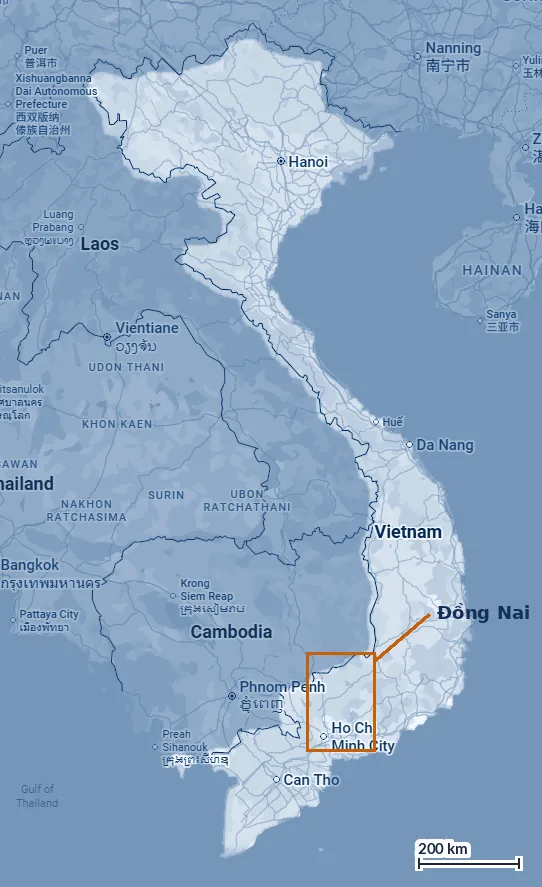
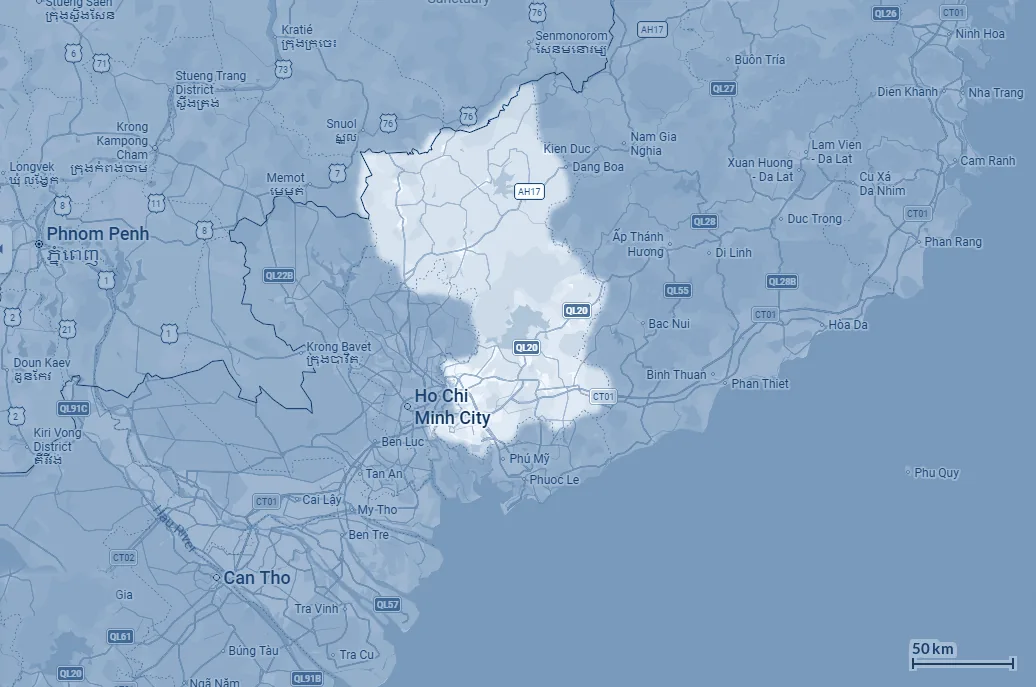
Where a foreign industrial project usually lands. Đồng Nai is Vietnam’s first industrial basin and still its densest concentration of foreign manufacturing in the south — some thirty-two industrial zones, the largest cluster in the country. It has changed status twice in under a year: merged with the former province of Bình Phước on 1 July 2025, then raised to centrally-run municipality on 30 April 2026, the country’s seventh. The substance has not moved, but the competent authority has, and a dossier addressed to the former provincial body is returned.
The procedure, step by step
Vietnam is the most generous of the three jurisdictions with statutory time limits: most steps have one. What it does not regulate is what happens before — the authentication of documents abroad — and what happens at the bank.
Of everything in this note, the ninety-day capital contribution is the obligation clients most often discover late. It runs from the ERC, not from the bank account, and the bank has no obligation to be ready in time. The sequence that works is to open the capital account immediately on issue of the ERC and to have the funds identified, sourced and explainable before the account is opened — not after.
Where capital is contributed in kind, the time taken to transport the assets and complete import formalities is excluded from the ninety days. Cash is not so forgiven.
The first year, once the certificates are issued
| Obligation | When |
|---|---|
| Charter capital contributed in full | Within 90 days of the ERC |
| Value added tax returns, and electronic invoices | Monthly or quarterly according to turnover, from the first period |
| Provisional corporate income tax | Quarterly, with an annual finalisation within 90 days of the year end |
| Personal income tax withheld on employees, residents and non-residents alike | Monthly or quarterly, with an annual finalisation |
| Social, health and unemployment insurance | Monthly, from enrolment within 30 days of the labour contract |
| Labour reports to the provincial authority | Twice yearly |
| Audited financial statements, and the investment report to the licensing authority | Annually. An audit is compulsory for a foreign-invested enterprise |
How we help
We begin with the documents abroad, because it is the only part of a Vietnamese incorporation with no deadline anywhere and the part that quietly costs weeks. We draw the business lines against the VSIC classification and against Vietnam’s WTO commitments before anything is filed, since a line that turns out to be conditional changes the whole timetable and is far cheaper to find at the start. We choose the province and, where it helps, the industrial zone deliberately: the certificates are provincial, and practice differs. Then we run the ninety days as a project of its own — capital account opened on issue of the ERC, funds identified and explainable in advance — because that is the deadline that binds the investor rather than the administration. And because the framework was rebuilt between 2025 and 2026, we re-verify the governing texts and the competent authority for every file rather than working from the last one.