

Taiwan: investment approval and the science-park corridor
Who approves, in what order the money and the filings move, which investors face a harder road, and where the incentive sits
Taiwan is not a place you register in and then think about. A foreign investor is approved before the company exists, the capital is verified before the company is registered, the origin of the money decides how hard the approval is, and the location decides the incentive. This note takes them in the order a project meets them.
Approval comes first
Under the Statute for Investment by Foreign Nationals, every foreign investment in a Taiwanese company needs the prior approval of the Department of Investment Review of the Ministry of Economic Affairs — the authority formerly called the Investment Commission. The application identifies the investor, the amount, the activity and the intended shareholding, and it is the point at which sector restrictions bite. The only exceptions are a branch and a representative office of a foreign company, which are registered but not approved. On a complete file, review takes about six to eight weeks; large or sensitive files take longer.
| Step | What it establishes |
|---|---|
| Investment approval | That a foreign investor may hold this activity, at this percentage. Restricted and prohibited sectors are listed; several service and infrastructure activities carry ownership caps in their own statutes. |
| Capital remitted | The approved amount is paid into the company’s preparatory account, in one remittance or in instalments. Capital brought in outside this route, or before approval, is not recognised as foreign investment. |
| Capital verified | A Taiwanese accountant certifies the capital, and the Department confirms it by letter. Each remittance is submitted within two months; the whole approved amount has to be in and verified within one year of the approval. |
| Company registration | Legal existence of the entity — company limited by shares, or limited company — with its capital, directors and registered address. It follows the verification letter; it does not precede it. |
| Tax registration | The company’s registration with the tax authority for income tax and VAT, and the right to issue invoices. |
Registering the company first, or remitting capital before approval, cannot be repaired afterwards: the money is not foreign investment, and the company has to be rebuilt around it. Most of the quarter a Taiwanese project loses is lost here.
Whose money it is
The approval is not the same hurdle for every investor. Three cases are worth separating before a structure is chosen.
| Investor | What changes |
|---|---|
| Foreign investors generally | Approval under the Statute, outside a short negative list. Once approved, national treatment and free repatriation of profits. |
| Mainland Chinese investors | Only the sectors on the Department’s positive list are open. A mainland investor is a mainland person, but also a company incorporated elsewhere in which mainland persons hold more than 30 percent — tested at each level of the chain — or exercise control. Mainland government bodies may not invest at all. Investing without approval draws fines of NT$120,000 to NT$25 million (about US$3,700 to US$770,000, at NT$32.3 to the US dollar, 16 October 2026), suspension of the shareholder’s rights and possible forced divestment, and the penalties reach the Taiwanese nominee as well. |
| Hong Kong investors | Applications are examined more closely and take longer than applications from other foreign investors. |
It is common to put a Hong Kong company above the Taiwanese entity. For Taiwan that is a structure to test against the Department’s treatment of Hong Kong investors, and against the 30 percent rule if any mainland person sits in the chain, before it is adopted. Where another jurisdiction is cleaner for the file, we say so before the costs are committed.
Subsidiary, branch or representative office
A company limited by shares is the standard subsidiary and the only form that can be listed; it needs two shareholders, or a single government, juristic or corporate shareholder, and a closely held variant of up to fifty shareholders may restrict the transfer of its shares. A limited company is the lighter form: the members’ liability stops at their contribution, governance is simpler, and it cannot offer its shares to the public. Both need approval when foreign-held. A branch is not a separate entity — the parent carries its liabilities — but it needs no approval, is taxed on its Taiwanese income and is not subject to the retained-earnings surtax. A representative office may only conduct liaison and market research: no invoicing, no revenue. The choice is usually decided by whether the activity generates local revenue, and by how the group wants profits to come home.
The corridor, and why location decides the incentive
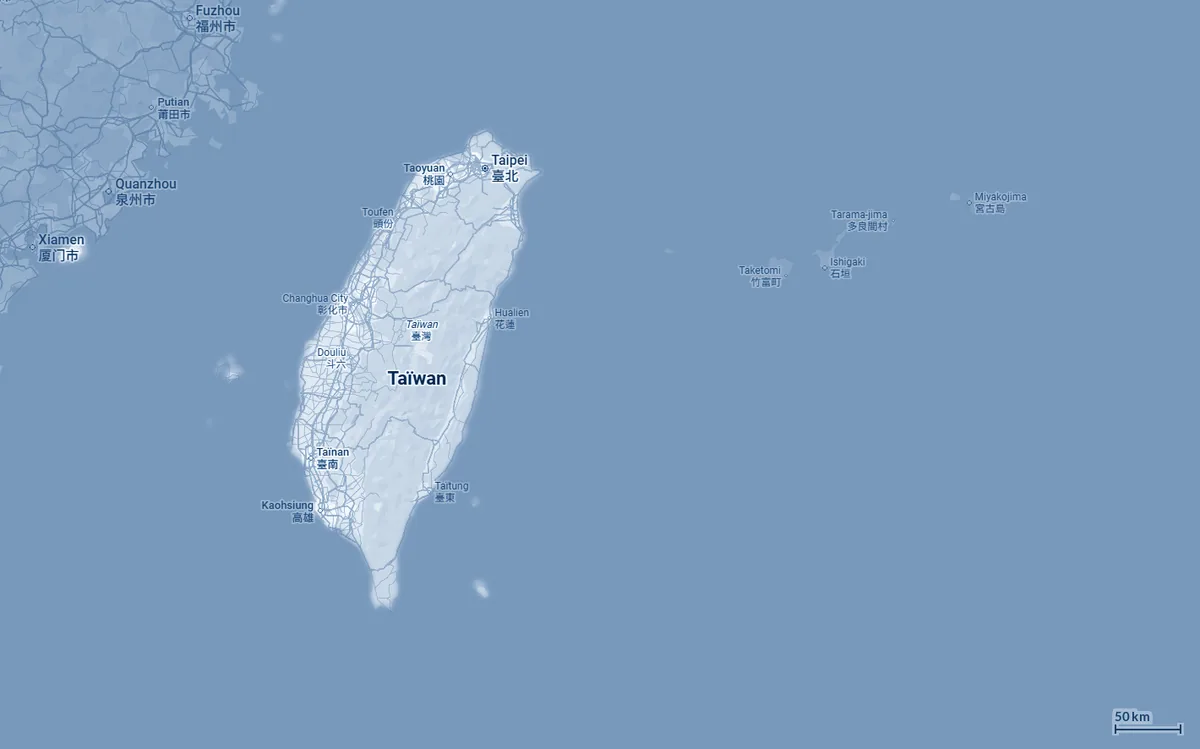
Taiwan’s advanced manufacturing is concentrated along a corridor from Hsinchu in the north to Tainan in the south, organised around three science parks and their satellites. Location inside a park is not merely an address: it carries eligibility for facilities, land arrangements and, for qualifying activities, tax treatment.
Alongside the parks, the research and development credit is the incentive most foreign investors actually use. It sits in the Statute for Industrial Innovation, which was amended in May 2025 to bring artificial intelligence and energy saving within its credits; the list of sectors eligible for the research credit was updated on 23 October 2025 and covers semiconductors, electric vehicles, and communications and display technologies. The credit rewards work done in Taiwan, which is the point — the regime is built to attract the activity, not the registration.
Three questions decide it, and they are cheaper to answer before the lease than after: does the activity qualify for park admission, or only for an ordinary industrial address; is the research actually performed in Taiwan, and documented well enough to support a credit claim; and where is the supply chain — Hsinchu for semiconductors, Taichung for machining, Tainan for packaging and biotech. Proximity to the cluster is worth more than the rent differential.
The founder’s own position
A company can be registered without anyone being resident. Running it is another matter: an employment permit, a residence visa and an alien resident certificate are separate applications, and the ordinary route requires the Taiwanese employer to exist first — which puts the founder in the position of needing the company before the company can sponsor them. The Employment Gold Card, applied for by the individual, breaks that circle. The two routes, and the 2026 reform of the foreign professionals law, are the subject of the next note in this series, Working in Taiwan.
Tax, in outline
The company
Profit-seeking enterprise income tax at 20 percent on the company’s income, and a 5 percent surtax on earnings not distributed by the end of the following year — from which a branch is exempt. VAT is 5 percent. Research credits and park-related treatment are claimed against the income tax, on evidence.
Getting profits out
Dividends paid to a foreign shareholder bear withholding tax of 21 percent, reduced where a tax agreement applies. A branch remitting profits to its head office is treated differently from a subsidiary paying a dividend — one of the reasons the branch-versus-subsidiary choice is made at the start rather than revisited later.
How we work on Taiwan
Lo On Shing does not maintain a Taiwanese establishment, and we say so plainly. What we do is the part that decides the outcome before anyone files anything: whether the activity belongs in Taiwan at all, given the investor’s profile and the sector; the structuring of the holding above the Taiwanese entity; the group’s compliance and beneficial-ownership documentation; and the coordination of Taiwanese counsel for the approval and registration themselves. Where a project does not fit Taiwan, we say so before the costs are committed.
Verification of Taiwanese entities — registration, officers, litigation and enforcement records — runs through our China Company Search Services alongside Mainland China, Hong Kong and Macau. It is the same question a European regulated professional has to answer about any counterparty, and Taiwan is covered.