

China’s trade agreements and the Belt and Road
Twenty-three agreements, six corridors and one sea route — and the gaps between them, which are where the cost sits
The Belt and Road is usually presented as infrastructure, and China’s free-trade agreements as trade policy — as though they were two programmes. For a company actually moving goods they are one question asked twice: the corridor decides whether the freight can get there and how fast, the agreement decides what it pays on arrival. A railhead without an agreement is a faster way to pay the ordinary tariff.
The six corridors, and the sea
The structure was fixed by the Vision and Actions document of March 2015 and has not changed since: six land corridors and the 21st Century Maritime Silk Road.
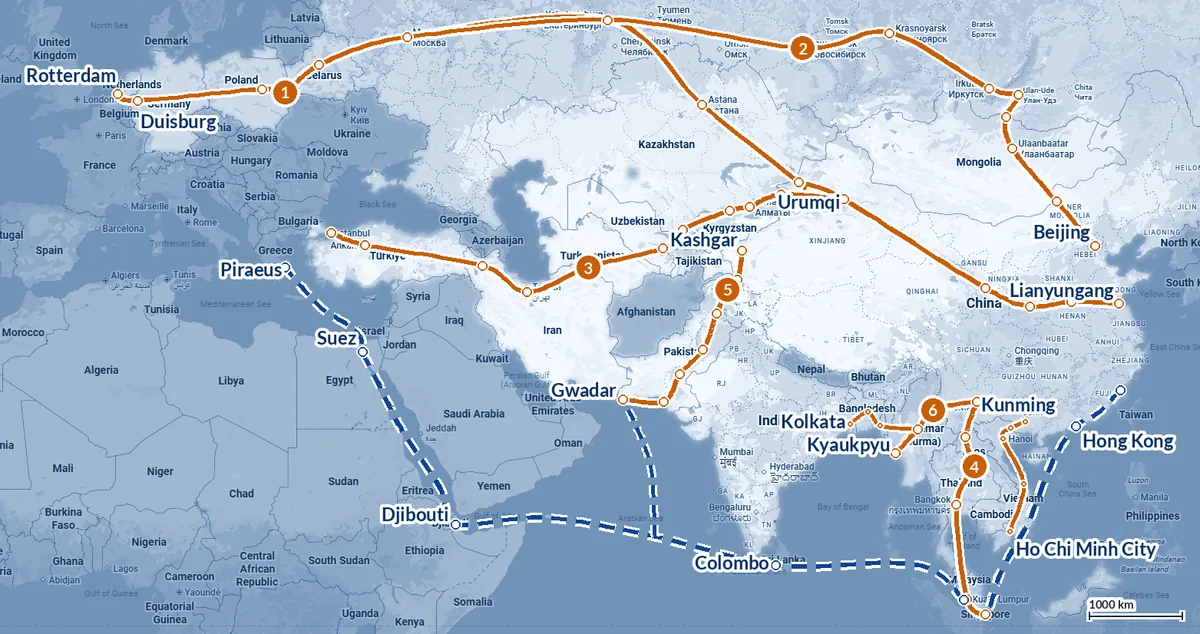
The corridor names, abbreviations and the countries each crosses are official. The cities are not: no official text sets out an itinerary town by town, so any map that names stations — ours included — is reconstructing them from the flagship works, and the alignments above are indicative. Nor is the lighter zone a map of who has joined the initiative. India, which the sixth corridor names in its own title, has never signed up to it and objects to the fifth.
The China–Europe Railway Express had run 120,000 trips carrying more than USD 490 billion of cargo by 28 November 2025, reaching 232 cities in 26 European countries. That is a real service and a genuine option for goods where two weeks against five weeks is worth the freight rate — electronics, components, seasonal goods, anything where working capital sits in the container.
It is not a substitute for the sea. A single large container ship carries more than a hundred of those trains. The corridor question for a European company is therefore narrow and practical: which of my shipments are time-sensitive enough to pay for rail, and does an agreement apply at either end.
| Corridor | Route, and what carries it | |
|---|---|---|
| 1 | New Eurasian Land Bridge NELB | Lianyungang and the eastern seaboard through Xi’an and Urumqi, across at Alashankou–Dostyk, then Kazakhstan, Russia, Belarus and Poland to Duisburg and Rotterdam. This is the China–Europe rail corridor. |
| 2 | China–Mongolia–Russia CMREC | Beijing through Erenhot and Ulaanbaatar to the Trans-Siberian, then west to Moscow. The northern alternative to corridor 1, and the shorter of the two for northern China. |
| 3 | China–Central Asia–West Asia CCWAEC | Urumqi through Khorgos, Almaty, Tashkent and Tehran to Turkey and the Mediterranean, with branches toward the Gulf. Five Central Asian republics, none of which has a trade agreement with China. |
| 4 | China–Indochina Peninsula CICPEC | Kunming through Laos to Bangkok, Kuala Lumpur and Singapore, carried by the China–Laos railway since December 2021; an eastern branch runs from Nanning through Hanoi to Ho Chi Minh City. The only corridor covered end to end by trade agreements. |
| 5 | China–Pakistan CPEC | Kashgar over the Khunjerab Pass to Islamabad, Karachi and the port of Gwadar. Called the initiative’s flagship project, and the only corridor that reaches blue water without passing Malacca. |
| 6 | Bangladesh–China–India–Myanmar BCIMEC | Kunming through Ruili and Mandalay to Kyaukpyu on the Bay of Bengal, with branches to Chattogram, Dhaka and Kolkata. The least advanced of the six. |
| — | Maritime Silk Road | The Chinese coast through Hong Kong and the South China Sea, Malacca, Colombo, the Arabian Sea, Bab el-Mandeb, Suez and the Mediterranean to Piraeus and northern Europe. It still carries the overwhelming majority of the tonnage. |
The agreements
China has 23 free-trade agreements in force with 30 countries and regions, on its Ministry of Commerce’s own count of January 2025. They are listed below in order of entry into force. The great majority of these partners are also Belt and Road signatories; the significance of the list is as much in what is missing from it.
| Partner | In force | Note |
|---|---|---|
| Hong Kong — CEPA | 1 January 2004 | China’s first. Zero duty on Hong Kong-origin goods since 2006. |
| Macao — CEPA | 1 January 2004 | Signed the same year, on the same model. |
| ASEAN — ACFTA | 2005 (goods) | Upgraded in 2015. The 3.0 protocol, signed 28 October 2025, is not yet in force. |
| Pakistan | 1 July 2007 | Phase II in force since 1 December 2019. Carries corridor 5. |
| Chile, New Zealand, Singapore, Peru | 2006–2010 | The first generation outside Asia. New Zealand upgraded in 2022, Singapore in December 2024; the Peru upgrade protocol of November 2024 is not yet in force. |
| Costa Rica, Iceland, Switzerland | 2011–2014 | Iceland was the first agreement with a European state; the Swiss upgrade was concluded as a memorandum on 21 August 2026 and the protocol is not yet signed. |
| South Korea, Australia | 20 December 2015 | Both on the same day. The two largest by trade value after ASEAN. |
| Georgia, Maldives, Mauritius, Cambodia | 2018–2025 | Mauritius was the first with an African state; the Maldives agreement waited eight years between signature and force. |
| RCEP | 1 January 2022 | Fifteen economies, one set of origin rules. The most consequential of them all — see below. |
| Nicaragua, Ecuador, Serbia | 2024 | Serbia is the second European agreement, in force 1 July 2024. |
Read the two lists against each other and the gap is stark. Corridors 1, 2 and 3 — the entire overland route to Europe — cross no Chinese free-trade area between the Chinese frontier and Warsaw. Russia, Belarus, Kazakhstan, Uzbekistan, Turkmenistan, Iran, Turkey: infrastructure, yes; tariff preference, no.
There is no agreement with the European Union, none with India, none with the Gulf states, none with the United States. Corridor 4, through Laos to Singapore, is the only one of the six covered end to end by agreements — ASEAN–China and RCEP together. That is not a coincidence, and it is the reason a European group building an Asian supply chain so often ends up with a Chinese plant and a Vietnamese one rather than a single site.
RCEP, which is the one that changed the arithmetic
In force for China since 1 January 2022, RCEP puts China, Japan, South Korea, Australia, New Zealand and the ten ASEAN states under a single rule of origin. A component made in any member counts as originating in all of them. For a European group with plants in more than one Asian country, that regional cumulation is worth more than most of the individual tariff schedules: it is what allows a Chinese sub-assembly and a Vietnamese final assembly to qualify together.
Every general account of RCEP describes three ways to prove origin, one of them exporter self-certification. China — with Vietnam — took a reservation permitting it to delay implementing self-certification for up to ten years from entry into force, that is potentially to 2032. For goods entering China, expect to need an authority-issued certificate of origin, whatever your own country’s RCEP implementation allows for other destinations. This catches exporters who read the agreement and not the reservation.
What a European company can rely on, and what it cannot
| Question | The position in 2026 |
|---|---|
| Can my Chinese subsidiary use these agreements? | Yes. A foreign-invested enterprise established in China is a Chinese enterprise for this purpose and exports to ASEAN, Korea, Australia or the RCEP area on the same terms as any domestic company. This is the principal commercial argument for manufacturing in China rather than shipping from Europe. |
| Is there an EU–China agreement? | No, and there is no negotiation. The Comprehensive Agreement on Investment was concluded in principle in December 2020 and frozen by the European Parliament in May 2021 over counter-sanctions; the Parliament’s own tracker still records it as blocked. It confers no rights whatever. |
| So what protects my investment? | The bilateral investment treaty between your own member state and China, where one exists. These differ substantially — in scope, in the standard of protection and in the dispute mechanism — from one member state to another. It is a question to settle before the holding structure is fixed, not after. |
| How is origin proved? | By certificate, issued by customs or the CCPIT, one form per agreement. Product-specific rules differ between agreements: goods that qualify under ASEAN–China may fail under RCEP and the reverse. The election is made per consignment. |
| What governs whether I may enter a sector at all? | The national negative list — manufacturing was fully opened in the edition effective 1 November 2024 — and the shorter free-trade-zone list. What is not listed is open to a foreign investor on the same terms as a domestic one. |
| And the United States? | No free-trade agreement, and none in prospect. The framework announced in October 2025 is a political arrangement, not a treaty: a reciprocal tariff on Chinese goods remains, and it is not something a European group can plan around as if it were law. |
What we check on a file
We establish which agreements actually reach the destination market before discussing the route, because a corridor without an agreement changes the transit time and nothing else. Where two agreements reach the same market — ASEAN–China and RCEP both cover Vietnam, Thailand and Malaysia — we compare them consignment by consignment rather than standardising on one, since the product-specific rules differ and so does the paperwork. We check that the origin rule can be met by the manufacturing process actually intended, before the process is fixed. We read the negative list edition in force on the day, not the one in the last memorandum. And on investment protection we look at the treaty between the specific member state and China, because there is no European agreement to fall back on and the answer genuinely differs by jurisdiction.