

Verifying a Chinese business licence
What the licence records, how to test it against the national register, and what it cannot tell you
Download this note as a PDF Version française (PDF)
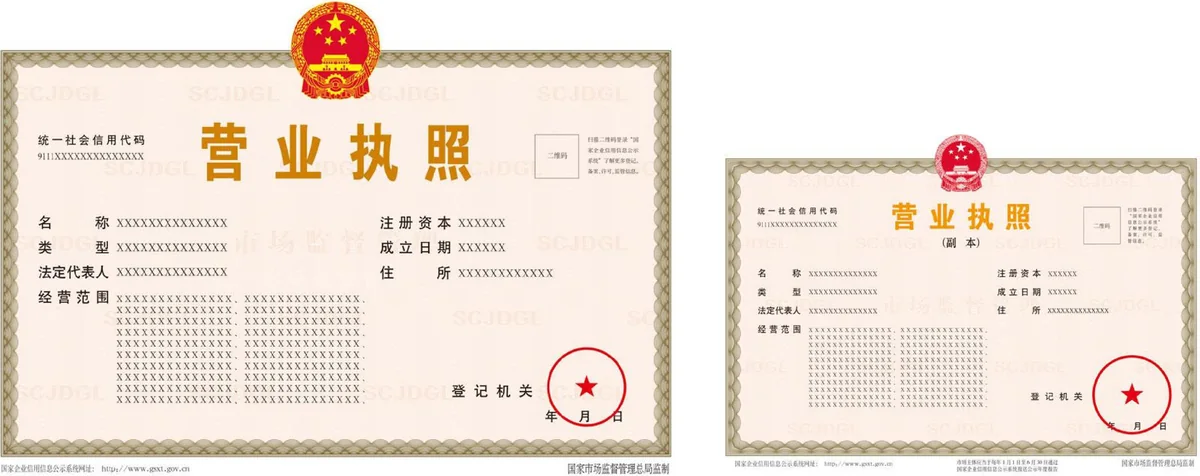
The business licence (营业执照) is usually the first document a mainland Chinese counterparty sends, and often the only one. On its own, a scan of it proves very little: an image is easy to alter, and even a genuine licence describes the company as it stood on the day it was issued. Its value lies in the national register behind it, which is public and authoritative. This note sets out what the licence records, how to test it against that register, and why a genuine licence opens a due-diligence file rather than closing it.
What is a Chinese business licence?
It is the certificate that proves a company has been registered. It is issued by the local administration for market regulation (市场监督管理局) of the place where the company is registered, under the supervision of the State Administration for Market Regulation (SAMR). The rules are those of the Regulations on the Registration of Market Entities (State Council Decree No. 746, in force since 1 March 2022) and of their Implementing Rules (SAMR Order No. 52).
| In short | What it means in practice |
|---|---|
| One licence, one code | Since the 2015 “three certificates in one” reform, the licence carries the unified social credit code, which replaced the separate business registration number, organisation code and tax registration number. Social insurance and statistical registration were folded in from 1 October 2016. |
| Original and duplicate | The licence exists as an original (正本), to be displayed at the company’s domicile, and a duplicate (副本). Both have the same legal effect. |
| Paper or electronic | The electronic business licence (电子营业执照) has the same legal effect as the paper one (Decree No. 746, art. 22). The company holds it on an authenticated account; a third party sees it only when the company presents it. |
| A QR code on the current format | The format issued since 1 March 2019 carries a QR code that opens the company’s page on the national register. Licences issued earlier remain valid. |
| Protected by law | Forging, altering, leasing, lending or transferring a licence is prohibited (Decree No. 746, art. 37). |
What does the licence record?
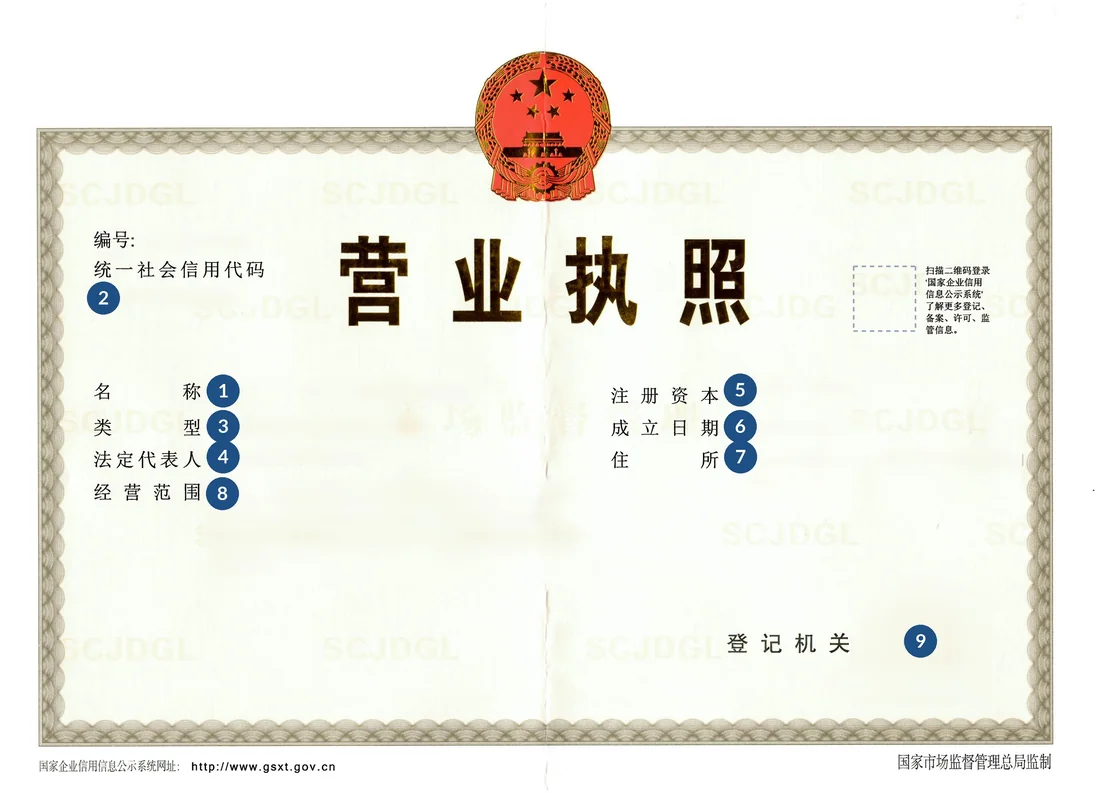
Article 23 of the Implementing Rules lists nine particulars. Each can be compared with the register, and each tells you something specific.
| On the licence | What it is | What to check |
|---|---|---|
| Name 名称 | The company’s only registered name, in Chinese. An English name is a translation the company makes itself; it is not registered. | That the Chinese name on the contract, the invoices (发票) and the bank account is identical, character for character. |
| Unified social credit code 统一社会信用代码 | The company’s identifier for life. It does not change when the company changes its name, address or shareholders. | That it passes the test described below, and that the register returns the same company for it. |
| Type 类型 | The legal form — for example a limited liability company (有限责任公司), a wholly foreign-owned one (有限责任公司(外国法人独资)), a company limited by shares (股份有限公司), or an individual business (个体工商户). | That the form is the one you were told. An individual business is not a company: it has an operator (经营者), not a legal representative, and the operator answers for its debts personally. |
| Legal representative 法定代表人 | The natural person who acts for the company by law, without a power of attorney. | That the person signing is this person, or holds a written authority from the company. |
| Registered capital 注册资本 | The capital the shareholders have subscribed. | Nothing, on its own: it states what was promised, not what was paid. |
| Date of establishment 成立日期 | The date on which the company was first registered. | That it fits the history you were given. “Twenty years in the trade” and a company formed last year do not match. |
| Domicile 住所 | The registered address. | That it matches the contract — and whether the company actually operates there. |
| Business scope 经营范围 | The activities the company is registered to carry on. Activities subject to a permit are marked as such, and may not be carried on until the permit is granted. | That the contract falls within the scope and, for a regulated activity, that the permit exists. |
| Registration authority 登记机关 | The authority that registered the company, with its seal and the date of issue. | That it is consistent with the domicile, and that the date of issue is recent enough to reflect the last registered change. |
Licences issued under earlier rules may also show a business term (营业期限). SAMR removed it from the face of the licence on 1 September 2022, together with the operating term (经营期限) and the partnership term (合伙期限). It is now a filed item rather than a particular of the licence, and the register still shows it. A licence that carries it was printed before that date.
How do you check a licence against the register?
The authoritative source is the National Enterprise Credit Information Publicity System (国家企业信用信息公示系统, www.gsxt.gov.cn), operated by SAMR. It is public and free of charge. Its interface is in Chinese, every search is preceded by a visual verification, and access from outside mainland China can be slow or refused.
| On the register | What it means |
|---|---|
| Existing 存续(在营、开业、在册) | The company is registered and may trade. |
| Business suspended 歇业 | The company has filed a suspension of business, for three years at most (Decree No. 746, art. 30). It still exists, but does not trade. |
| Licence revoked 吊销 | The licence has been withdrawn as a penalty. The company exists until it is deregistered, but may no longer trade — hence the frequent mention “吊销,未注销” (revoked, not deregistered). |
| Deregistered 注销 | The company no longer exists. |
| Moved out 迁出 | The company has moved to another registration authority, which now holds its record. |
| Registration cancelled 撤销 | The registration itself has been annulled, typically because it was obtained with false documents. |
A licence records the company on the day it was issued. The status, the shareholders, the capital paid in and any listing on the risk lists all change afterwards, and only the register shows them. A copy that is a year old can be entirely genuine and still describe a company that has since been struck off.
How do you read the unified social credit code?
The code is defined by the national standard GB 32100-2015. It has eighteen characters, drawn from the digits 0 to 9 and the capital letters other than I, O, S, V and Z, in five parts.
| Position | Length | What it encodes |
|---|---|---|
| 1 | 1 | Registration authority — 9 for market regulation, which registers companies; 1 for institutional organisation authorities (机构编制); 5 for civil affairs (民政); Y for other authorities. |
| 2 | 1 | Category — under 9: 1 for an enterprise, 2 for an individual business, 3 for a farmers’ professional cooperative. |
| 3 – 8 | 6 | Administrative division of the registration authority at the time of registration — for example 440300 for Shenzhen. The code does not change when the company moves, so a division that differs from the current address is a question to ask, not proof of forgery. |
| 9 – 17 | 9 | Subject identifier — the organisation code, whose last character is itself a check character. |
| 18 | 1 | Check character, computed from the first seventeen. |
How is the check character computed?
Each of the first seventeen characters is given a value — 0 to 9 for the digits, then 10 to 30 for the letters A to Y, skipping I, O, S, V and Z — and multiplied by a fixed weight. From the first position to the seventeenth, the weights are 1, 3, 9, 27, 19, 26, 16, 17, 20, 29, 25, 13, 8, 24, 10, 30 and 28. The products are added up and the sum is divided by 31. The check character is the one whose value is 31 minus the remainder; a result of 31 gives 0.
First seventeen characters: 9 1 1 1 0 0 0 0 0 0 0 0 0 0 0 0 0
Sum: 9×1 + 1×3 + 1×9 + 1×27 = 48 — divided by 31, remainder 17
31 − 17 = 14, which is the value of the letter E
Complete code: 91110000000000000E
Because 31 is a prime number and no two weights are equal, a single mistyped character, or two neighbouring characters swapped, always yields a different check character. The test therefore catches careless alterations. It does not catch a forger who copies the valid code of another company: only the register does.
What does the licence not tell you?
| The licence does not show | Where the answer is |
|---|---|
| Whether the company is still active | The registration status on the register. |
| Whether the capital has been paid | The shareholders’ subscribed and paid-in contributions, which the company must publish on the register within twenty working days of any change, and again in its annual report (Enterprise Information Publicity Regulations, arts. 9 and 10). |
| Who owns the company | The shareholders appear on the register. Beneficial owners are filed with the registration authority under the PBOC–SAMR Measures in force since 1 November 2024, but that information is not public. |
| Whether it is in litigation or under enforcement | Court records, including the list of dishonest judgment debtors (失信被执行人) published through the Supreme People’s Court. |
| Whether it holds the permits its business needs | The permits themselves, issued by the competent authority. Administrative permits and penalties are also published on the register. |
| Whether the person you deal with may bind it | The legal representative is named on the licence; anyone else needs a written authority from the company. Company seals are filed with the public security bureau and cannot be checked on the register. |
| Whether it is financially sound | The figures in the annual report — assets, liabilities, revenue, profit, tax paid — are published only if the company chooses to publish them (art. 9). |
Under article 47 of the Company Law, as revised on 29 December 2023 and in force since 1 July 2024, the shareholders of a limited liability company must pay in the capital they subscribe within five years of its establishment.
Companies established before 30 June 2024 with a longer schedule must bring their remaining period within five years from 1 July 2027, and amend their articles accordingly before 30 June 2027 (State Council Decree No. 784, art. 2). A large registered capital on a licence may therefore still be largely unpaid. The register shows what has actually been contributed.
Which signs should make you stop and ask?
| Sign | Why it matters |
|---|---|
| The code has the wrong length, contains I, O, S, V or Z, or fails the check character. | It has been mistyped or altered. The licence cannot be relied on as it stands. |
| The register returns no company, or a different one, for the code. | The copy does not correspond to a registered company. Treat it as forged until it is explained. |
| The code begins with 92, or the type reads 个体工商户, although you were told you are dealing with a company. | You are dealing with an individual business, whose operator is personally liable. |
| The name on the invoices, the contract or the bank account differs from the licence, even by one character. | The payments may be going to another entity. |
| The status is anything other than existing, or the company is on the abnormal operations list or the list of seriously illegal and dishonest enterprises. | The company may be unable to trade, or has failed its filing obligations. |
| The date of establishment is recent compared with the track record you were given. | The track record belongs to another entity — or to none. |
| The business scope does not cover what you are buying. | The company may not lawfully perform the contract, or needs a permit it may not hold. |
| The QR code opens a page that is not on gsxt.gov.cn, or shows another company. | The code has been copied or tampered with. |
| Only a cropped or blurred image is offered, and a current licence is not forthcoming. | The document cannot be examined — and the reluctance is information in itself. |
A company is placed on the list of enterprises with abnormal operations (经营异常名录) by its registration authority when it fails to file its annual report on time, fails to publish information it was ordered to publish, publishes false information, or cannot be reached at its registered domicile. A company still on that list after three years is moved to the list of seriously illegal and dishonest enterprises (严重违法失信名单).
How can CCSS help?
For a company registered in Mainland China, the Corporate Lite Report sets out, in English and in Chinese, the registered identity of the company as it stands in the official register: registration number, legal status, legal form, company name, date of incorporation, registered address, legal representative, and the other registration identifiers.
It confirms that the company exists as a registered entity rather than a de facto one, and is often sufficient before a contract of modest value. It is delivered in seconds, upon order.
www.china-company-search.com — Report Types › Corporate Lite Report