

The Pearl River Delta
Nine mainland cities, Hong Kong and Macao — reading the Greater Bay Area from the mainland side
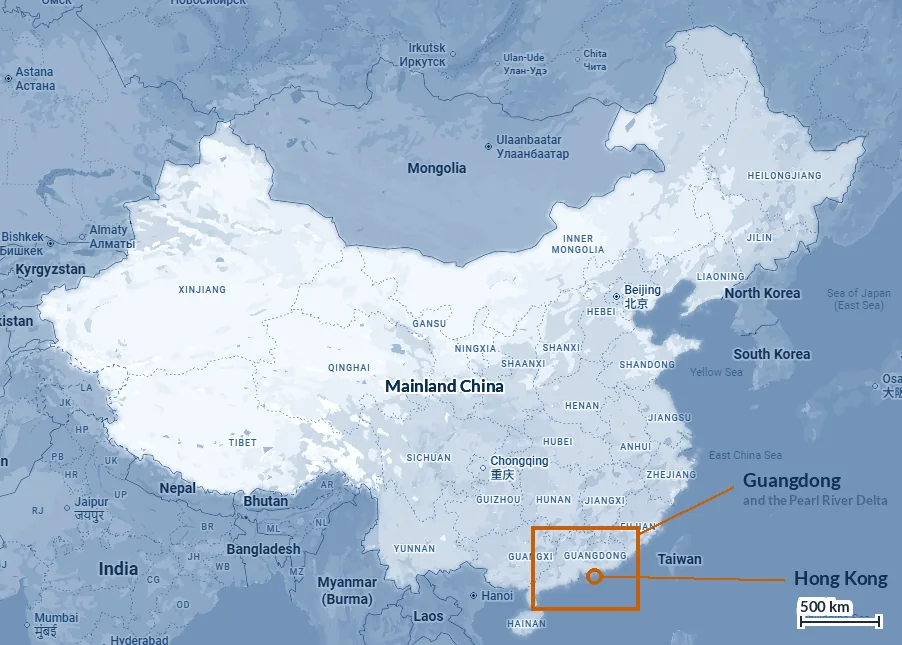
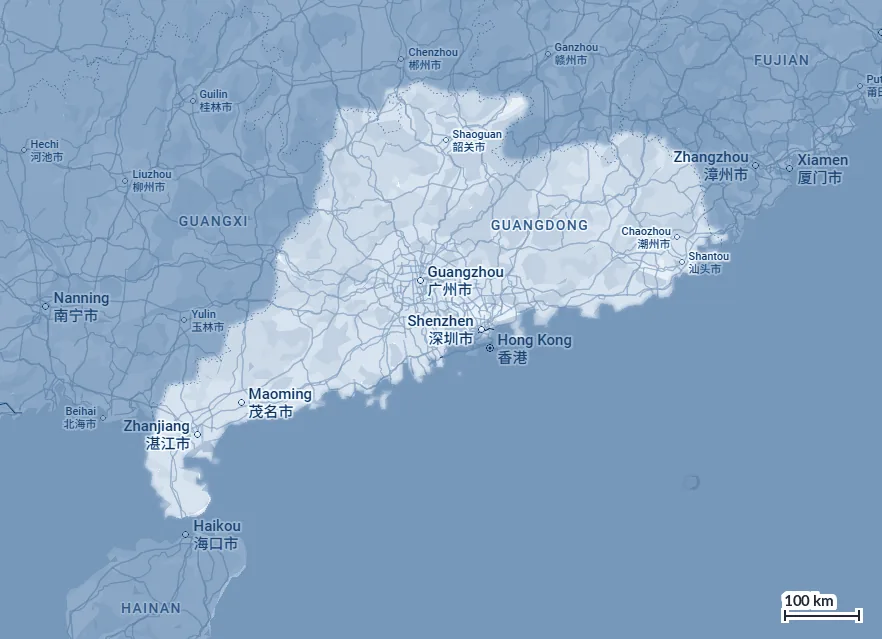
The Greater Bay Area is not a jurisdiction. It is eleven of them working as one market: nine cities of Guangdong plus the two special administrative regions, some 86 million people and around USD 2 trillion of output — an economy the size of a large European country, inside a two-hour radius. For a foreign investor its interest is precise: it is the one place in China where a mainland operating company and an offshore holding company sit an hour apart and were designed to work together.
Who does what
| City | What it is for |
|---|---|
| Shenzhen | Hardware, electronics, telecoms and software; the densest supply chain in the world for prototyping and short-run manufacturing. Qianhai is its cooperation zone with Hong Kong for modern services. |
| Guangzhou | Trade, automotive, chemicals, logistics; the historic commercial capital and the administrative centre of the province. Nansha is its cooperation platform. |
| Dongguan · Foshan | The manufacturing floor — precision machining, furniture, appliances, textiles, packaging. Where a European industrial subcontracting programme actually lands. |
| Zhuhai | Advanced manufacturing and biotech, and the land bridge to Macao through the Hengqin cooperation zone. |
| Zhongshan · Huizhou · Jiangmen · Zhaoqing | The second ring: lighting, hardware, chemicals, food, and the land available at a cost the first ring no longer offers. |
| Hong Kong · Macao | Common law, free capital movement, the holding, treasury, IP and dispute-resolution layer. Covered from the Hong Kong side in our companion note. |
What made it one market
Three fixed links changed the geography rather than merely improving it. The Hong Kong–Zhuhai–Macao bridge, opened in 2018, connects the eastern and western banks of the estuary by road for the first time. The Guangzhou–Shenzhen–Hong Kong Express Rail Link, opened the same year, puts West Kowloon within fourteen minutes of Shenzhen and about fifty of Guangzhou. The Shenzhen–Zhongshan link, opened in 2024, cuts the crossing between the two banks from around two hours to half an hour.
Three cooperation zones then gave the map a legal dimension: Qianhai in Shenzhen, expanded in 2021 and oriented to modern services and Hong Kong professional practice; Nansha in Guangzhou, with its 2022 development plan; and Hengqin in Zhuhai, jointly administered with Macao. Each carries its own set of preferential arrangements, and each is a plausible answer to “where do we register?” for a service business rather than a factory.
Across the nine mainland cities, qualifying overseas talent — including professionals from Hong Kong and Macao — receives a subsidy that brings the effective individual income tax burden down to around 15%, the difference being refunded by the local government. It is administered city by city, with its own qualifying list and its own filing calendar. It is the single most material incentive for a foreign-invested company deciding where in the delta to put its senior people.
What it means for how you structure
The delta rewards a two-layer structure: a Hong Kong company that holds, funds and contracts internationally, and a mainland company that manufactures, employs and invoices domestically. That pairing is not a tax scheme — it is a response to two facts. Capital moves freely in one and is administered in the other; and one operates under common law with an international arbitration seat, the other under PRC law.
Setting up the mainland company
A wholly foreign-owned enterprise, or a foreign-invested commercial enterprise for trading. Check the activity against the negative list before anything else. Since the 2024 Company Law, subscribed capital must be paid in within five years — so the registered amount is a cash-flow commitment, not a statement of intent. Beneficial owners are filed with the market regulator, which means the ownership chain up to the individuals is prepared before the file, not after.
Documents from abroad
Since China joined the Apostille Convention in November 2023, corporate documents from member states are certified by a single apostille. Documents issued in Hong Kong take a different route: attestation by a China-Appointed Attesting Officer, then transfer sealing. Getting this wrong is the most common cause of a file being sent back at the counter.
Choosing the city
The question is rarely “which is best” and usually “which is best for this activity”. A hardware business locates in Shenzhen or Dongguan and accepts the cost. A trading company that needs a bonded warehouse and a port looks at Nansha. A service company selling into the region and staffed with Hong Kong professionals looks at Qianhai. A manufacturer with land requirements looks at the second ring — Zhongshan, Huizhou, Jiangmen — where the delta's competitive advantage is now measured in square metres rather than in proximity.
Local market regulators verify that a registered address is a usable business address, and they visit. Subleases are accepted, but the file must identify the landlord and evidence the right to sublet — nine supporting documents in the standard case. In practice this is the item that most often delays a mainland incorporation, and it is settled before the file is lodged, not during it.
The Hong Kong side of the pair
Held from Hong Kong, the mainland subsidiary benefits from the mainland–Hong Kong double tax arrangement, under which dividend withholding falls to 5% for a holding of at least 25%, subject to the substance and beneficial-ownership conditions. Profits repatriated to Hong Kong meet a territorial tax system and no exchange control. That is the mechanical reason the pairing exists, and it is developed in the companion note, Hong Kong and the Greater Bay Area.
We incorporate the Hong Kong holding company and the mainland operating company as a single structure rather than two unconnected files, which is what keeps the capital route, the document certification and the beneficial-ownership filings consistent. Company intelligence on mainland counterparties — registration, shareholding, beneficial owners, litigation — runs through our China Company Search Services. And where a project needs a comparison before it needs an incorporation, we run it: delta, Hong Kong, or northern Vietnam, on the criteria that actually decide the answer.