

Establishing a New Co. in Mainland China
The wholly foreign-owned enterprise — what it takes, who decides, and how long each of them has
A WFOE is a Chinese limited liability company whose capital is held entirely abroad. Since 1 January 2025 it is governed by the ordinary Company Law, with no separate foreign-investment statute and no ministry approval. What remains is a registration — fast, and bounded by law. Around it sit four further steps on which no law imposes any deadline at all. This note keeps the two apart, because that is where the real timetable lives.
Why a WFOE
| In short | What it means in practice |
|---|---|
| Full foreign ownership | No Chinese partner is required. Since the 2024 negative list, foreign investment in manufacturing is open without restriction; other sectors follow the list, which is reissued almost every year. |
| A Chinese company in its own right | Since 1 January 2025 the WFOE sits under the ordinary Company Law, on the same footing as a domestic company — same organs, same capital rules, same filings. |
| No minimum capital | The law sets no floor and there is no verification. But what is subscribed becomes an obligation with a date on it — see below. |
| It trades and invoices locally | Issues fapiao in renminbi, employs directly, contracts in its own name, and repatriates profit after tax through its capital account. |
| Limited liability | The foreign parent is exposed to what it has subscribed, and to that alone. |
| Apostille, not legalisation | China has been party to the Hague Convention since 7 November 2023. Documents from member states are admitted under apostille; consular legalisation has been abolished for them. |
It is not always the right answer. A company that only wants a presence — market study, liaison, quality control — and will not invoice in China may be better served by a representative office, which cannot trade but costs far less to run. A company whose only need is to sell into China may not need an entity at all. We say so when it is the case; the WFOE earns its keep when local invoicing, local hiring or a local licence is genuinely required.
Where the WFOE is established, and why it decides so much
A WFOE is not registered in China; it is registered in a city. The city fixes the competent authority and the local tax bureau, the housing fund rate, the social insurance base, and the municipal average wage against which a foreign manager’s work permit category is later assessed. The same file, lodged three hundred kilometres apart, is not the same file.
The Pearl River Delta is where that choice is least arbitrary. Nine cities of Guangdong, with Hong Kong and Macao closing the ring, were deliberately built to work as one market — and it is the one place where the two-layer structure most European groups end up with stops being a tax idea and becomes a matter of geography: a Hong Kong company that holds, funds and contracts internationally, an hour from a mainland company that manufactures, employs and invoices domestically.
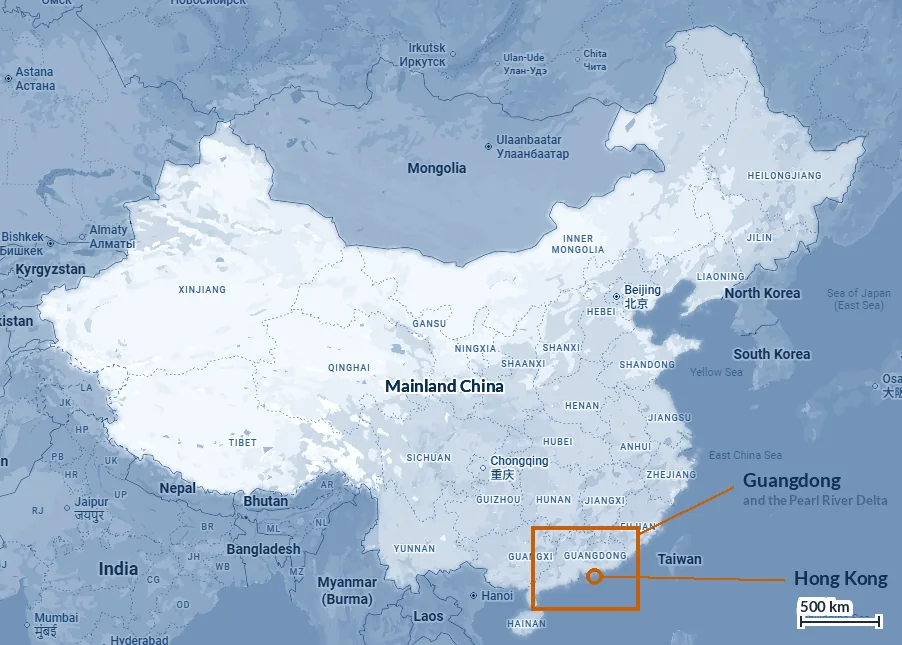
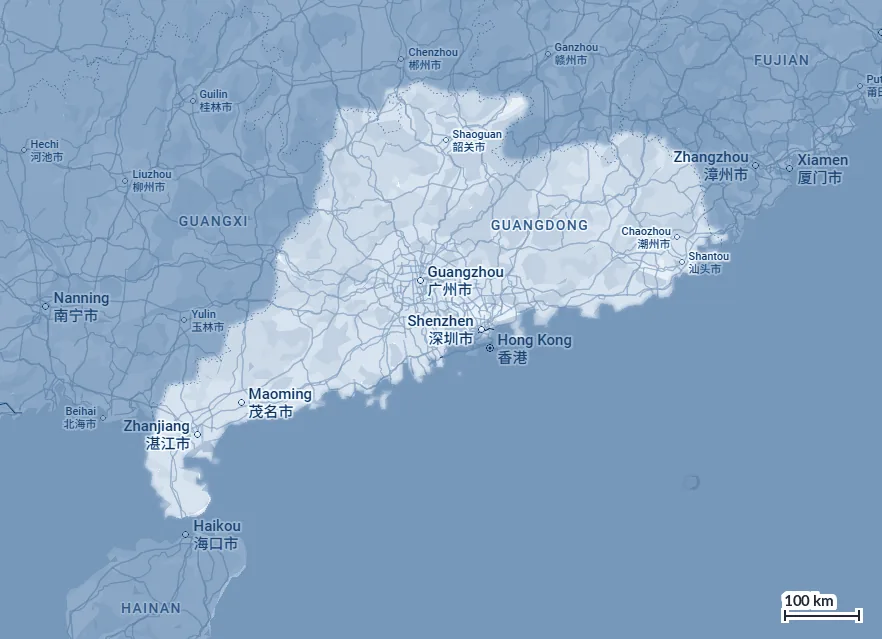
The delta is not one economy but half a dozen, and they are not interchangeable. Shenzhen is the high-technology pole — electronics, hardware, telecommunications, and the research that goes with them. Dongguan is the industrial floor, where much of that hardware is actually assembled. Guangzhou, the provincial capital, is the all-in-one municipality: services, high technology and industry together, with trade and logistics on top. Foshan carries advanced manufacturing — appliances, ceramics, machinery; Zhongshan lighting and metal hardware; and Zhuhai is the aeronautical centre of the delta, with its aviation industrial park and the airshow that has been held there for thirty years. Choosing between them is an industrial decision before it is an administrative one, and it is worth making before the lease is signed: the registered address fixes the competent authority, and the authority is not changed afterwards without re-registering the company.
Two consequences bear directly on the incorporation. Under the double tax arrangement between the Mainland and Hong Kong, withholding on dividends paid up to the Hong Kong parent falls from 10% to 5% where the holding is at least 25% — which is a reason to settle the shareholding structure before the licence is issued rather than after. And across the nine mainland cities, qualifying overseas talent sees its effective individual income tax burden brought down to around 15%, the difference refunded locally, administered city by city. Neither changes the procedure below; both change where it is worth running it.
Minimum requirements
| 1 | One shareholder is enough — an individual or a company, of any nationality. |
| 2 | A legal representative (法定代表人), who binds the company. May be a foreign national; residence in China is not required by law, but banks expect it in practice. |
| 3 | At least one director and one supervisor (監事), who cannot be the same person. |
| 4 | A real registered address in the city of establishment, evidenced by a lease. A virtual address is not accepted. |
| 5 | A business scope (经营范围) drawn from the official nomenclature and outside the foreign investment negative list. |
| 6 | Subscribed capital, in a stated currency, payable in full within five years. |
Under article 47 of the Company Law revised on 29 December 2023 and in force since 1 July 2024, the whole of the subscribed capital of a limited liability company must be paid up within five years of incorporation. The former regime let the members set their own horizon, and twenty or thirty years was common. That freedom is gone, and State Council Decree 784 of 7 June 2024 brings existing companies into line on a transitional timetable.
Setting a large capital to look substantial in front of Chinese counterparties now creates a dated debt of the European parent. Size the capital on the real cash requirement of the first five years, plus a margin — and not beyond it.
What has to be produced
What is needed depends on whether the shareholder is a company or an individual. Everything issued abroad must be apostilled and translated into Chinese.
| Provided by | Documents |
|---|---|
| Foreign corporate shareholder | Certificate of incorporation, apostilled · company extract or certificate of incumbency showing directors, shareholders and registered address · board resolution approving the establishment and the capital · bank reference letter less than six months old · certified passport copy of the signatory, with evidence of the power to sign |
| Foreign individual shareholder | Notarised and apostilled passport copy · proof of home address — utility bill or bank statement |
| Officers | Passport copies of the legal representative, the director or directors and the supervisor · letters of appointment and acceptance · photographs for the licence file |
| Premises | Lease in the name of the company being formed, and the landlord’s title deed |
Once the file is accepted, the Chinese counter is quick — three working days for the licence. The critical path is the production, translation and apostille of the parent company’s documents in Europe, over which Chinese law has no hold and for which no deadline exists anywhere. Start there, and start early.
Information we will ask you for
| No. | Item | Why it matters |
|---|---|---|
| 1 | Proposed company name | In Chinese characters. Since March 2021 the name is self-declared, not pre-approved; the system flags conflicts. Reserved for two months, within which the company must be registered. |
| 2 | Registered address | A real address in the city of establishment, with a lease. It determines the competent authority and the local tax bureau. |
| 3 | Business scope | Drawn from the official nomenclature. It limits what the company may do — unlike Hong Kong, where the description is indicative. Worth drafting wide from the outset. |
| 4 | Registered capital and currency | No minimum. Payable in full within five years. State the currency of contribution. |
| 5 | Legal representative, director, supervisor | Full name, nationality, passport number and expiry, home address, mobile, e-mail, date of birth. |
| 6 | Financial year | Not a choice: in China it runs from 1 January to 31 December. |
The procedure, step by step
Each step below carries the authority that decides, the time limit the law gives it, and the instrument that fixes that limit. Where no statutory deadline exists we say so, and the step is marked in orange. Those four are the ones that govern the real timetable, and they are the ones no brochure distinguishes.
The figures above are what the authorities are held to once a complete file has been accepted. Acceptance starts the clock — not submission. An incomplete file is not suspended: it is returned, and must be refiled in full, at which point the limit begins again from zero. That is where foreign files usually fail, on the chain of apostilled parent-company documents.
Published estimates of the total duration of a WFOE formation range from four weeks to six months depending on the source and the sector. We do not give a single figure, and we are wary of anyone who does.
The first year, once the licence is issued
| Obligation | When |
|---|---|
| Monthly or quarterly VAT returns, and quarterly corporate income tax | Within 15 days of the end of each period — nil returns included, from the first period |
| Annual corporate income tax settlement | By 31 May for the preceding calendar year |
| Annual report through the enterprise credit information publicity system | Between 1 January and 30 June, with the annual foreign investment report |
| Statutory accounts, and the audit report the annual settlement rests on | Prepared for the calendar year; the audit is required in practice for a foreign-invested company |
| Capital contributions | On the schedule declared in the articles, and in full within five years |
How we help
We take the file in the order that actually works. The European half first — corporate documents, resolutions, apostilles, sworn translations — because it is the only part with no deadline and the only part that can lose a month without anyone noticing. Then the business scope, drawn against the official nomenclature rather than translated from a European description, since it limits what the company may lawfully do. Then the registration itself, and the four steps around it where nothing is owed to anyone: we sit with the bank, we prepare the legal representative for the interview, and we say plainly when a bank is going to decline rather than letting a file age at a counter. We also produce the Hong Kong evidence the mainland asks for — certificates of incumbency, board resolutions, attestations — through the China-appointed attesting officer route, which is the correct one for the mainland and is not an apostille.