

Guangxi, China’s southern gateway to ASEAN
A new canal, a port above ten million containers and a regional expo with all eleven ASEAN members — what has been built, and what has not yet followed
Guangxi is the one Chinese region that borders ASEAN by both land (Vietnam) and sea (the Gulf of Tonkin, called the Beibu Gulf in China). For two decades Beijing and the regional government have been turning it from a remote frontier into the interface between western China and Southeast Asia. Autumn 2026 is a milestone: the Pinglu Canal opened on 16 September, and the 23rd China-ASEAN Expo (17–21 September, Nanning) gathered all eleven ASEAN members for the first time, Timor-Leste included. The infrastructure is largely in place. The industrial upgrade it was meant to trigger is not.
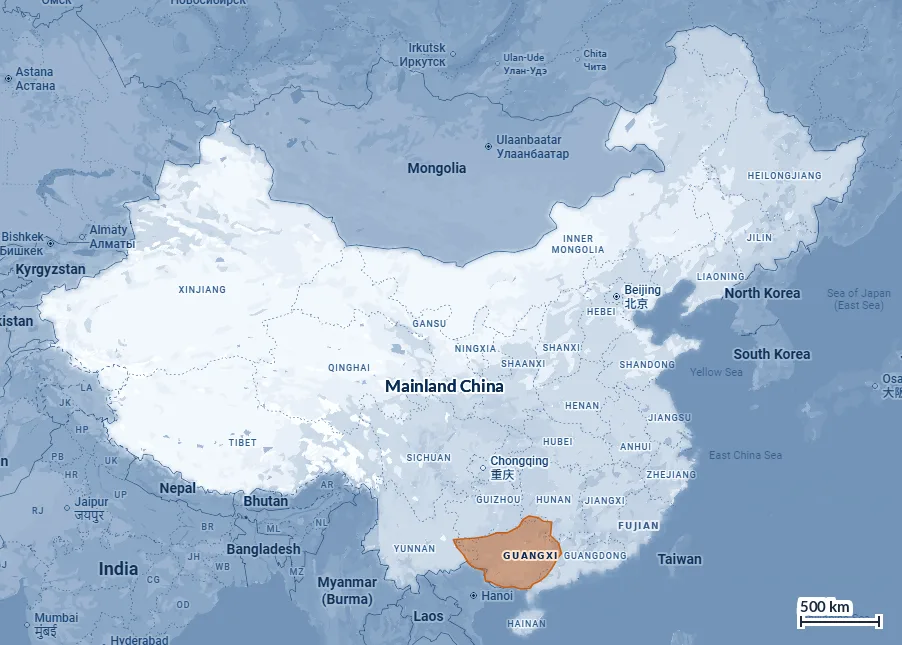
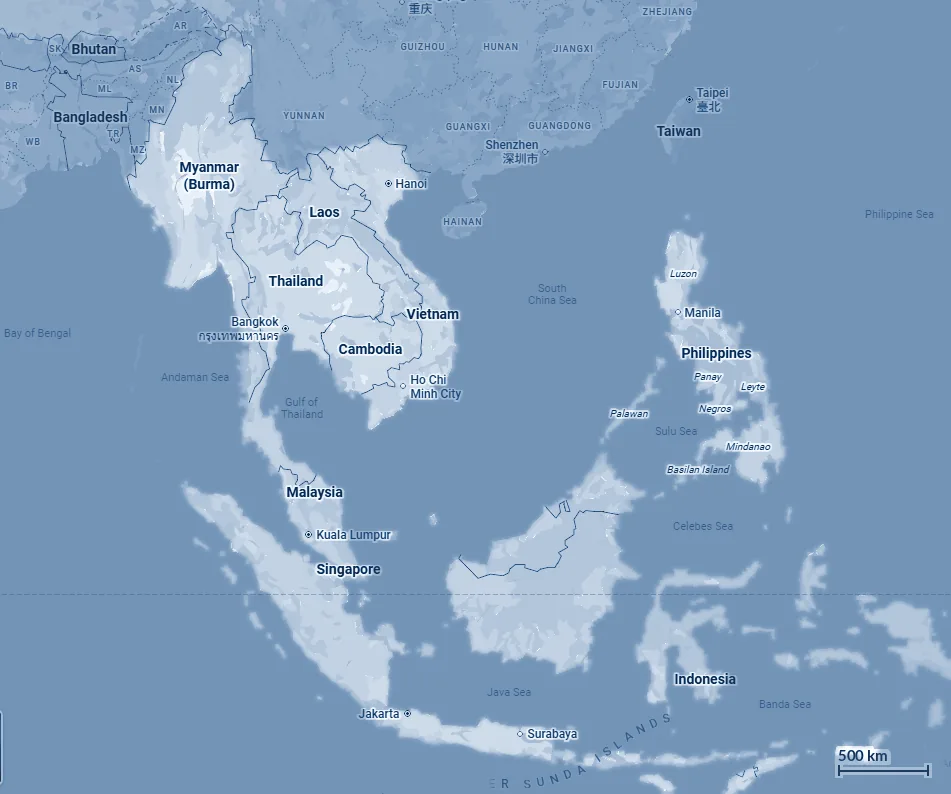
Exchange rate used throughout: US$1 = RMB 6.8 (mid-market, mid-2026 level). Press reports quoting the canal at US$10–10.4 bn used an older rate.
Why has Guangxi moved from the margin to the centre?
For most of the 20th century the border with Vietnam was a security question, not a trade route. The region served as a rear base during the Indochina wars and the 1979 conflict, and the opening-up policy of the 1980s largely bypassed it, even Beihai, which was one of fourteen coastal cities opened to foreign capital in 1984. The turn came with normalisation in the 1990s and a run of dated milestones.
| Year | Step |
|---|---|
| 2004 | China-ASEAN Expo starts in Nanning; China-ASEAN free trade agreement signed (fully in force 2010) |
| 2005 | Guangxi joins the Greater Mekong Subregion programme |
| 2010 | Nanning-Singapore economic corridor; China-ASEAN Investment Cooperation Fund |
| 2013 | Belt and Road Initiative launched |
| 2015 | New International Land-Sea Trade Corridor, from Chongqing to Singapore by rail and the Beibu Gulf ports国际陆海贸易新通道 |
| 2019 | China (Guangxi) Pilot Free Trade Zone |
| 2026 | Pinglu Canal opens; the Expo gathers all 11 ASEAN members |
How is the corridor built?
- Ports. Qinzhou (钦州), Fangchenggang (防城港) and Beihai (北海) are run by one regional state group, the Guangxi Beibu Gulf International Port Group. Qinzhou has China’s first automated container terminal combining sea and rail, built with COSCO Shipping, PSA International and Shanghai Zhenhua Heavy Industries. The port handled more than 10 million TEU in 2025 and serves over 200 ports in about 100 countries and regions.
- Rail and road. Two railway lines reach the Vietnamese border, backed by ten expressways leading to the crossings.
- Border zones. Pingxiang (凭祥) and Dongxing (东兴) are the two main crossings and run cross-border economic cooperation zones. Dongxing opened the first national RMB-dong exchange centre.
- The canal. The Pinglu Canal links the Xijiang river system near Nanning to the sea at Qinzhou. It shortens the inland route from south-west China to the sea by about 560 km compared with going through Guangzhou, with a stated initial capacity near 80 million tonnes a year and logistics-cost savings of 18–30 percent according to the regional government. Opening-day services included Nanning–Can Tho (Vietnam) and Nanning–Yangpu (Hainan). Some commentary still describes the canal as unfinished; it opened on 16 September 2026.
- Diplomacy. Nanning has an almost exclusive hold on the annual China-ASEAN Expo and its sector forums, including mining. Vietnam is by far the largest partner: trade with it exceeded RMB 300 bn (≈ US$44 bn) in 2025.
What is Guangxi trying to become?
The ambition is to be a processing and integration hub, not a transit corridor: ASEAN raw materials come in, semi-finished goods go out, and the most energy-hungry, lowest-margin stages stay across the border.
- Agri-food and metals. The China-Malaysia Qinzhou Industrial Park processes soya and palm oil. Guangxi is reported to hold China’s largest manganese and tin reserves and is building smelting capacity with ASEAN mining partners. Pingxiang hosts the China-ASEAN (Chongzuo) fruit trading centre: fresh durian imports reached 805,600 tonnes in 2025, worth RMB 22.9 bn (≈ US$3.4 bn).
- Digital. A stated model of “R&D in Beijing, Shanghai and Guangzhou, integration in Guangxi, application in ASEAN”, with a China-ASEAN AI application centre testing Chinese products in Laos, Malaysia and Indonesia.
- Vehicles. Liuzhou (柳州) builds on the GM-SAIC-Wuling cluster, and Guigang (贵港) hosts a China-ASEAN new-energy vehicle base.
- Exports. Mostly intermediate manufactured goods to ASEAN: electronics, appliances, auto parts, construction machinery, textiles and lithium batteries.
Where does the model fall short?
Nanning put about RMB 2.4 bn (≈ US$0.35 bn) into the parent of the Nezha electric-car brand. The company lost RMB 18.3 bn (≈ US$2.7 bn) over 2021–2023, stopped production in 2024 and has been in court-supervised restructuring since June 2025, with creditor claims of about RMB 26.6 bn (≈ US$3.9 bn). Chinese state television has criticised this kind of local race to attract projects.
- Weak foreign investment. Foreign investors are becoming fewer, put off by a legal environment and a talent pool seen as less attractive than in the coastal export provinces, which are also courting ASEAN. Cooperation agreements with Hong Kong and Singapore (legal services, executive training) are meant to close the gap.
- The canal is unproven. It is in a one-year trial operation until 15 September 2027, with a navigable depth of 6.3–6.5 m and vessels of up to 5,000 tonnes. Traffic, tariffs and profitability remain to be shown.
- Competition on the AI and electric-vehicle bets. Better-placed provinces pursue the same sectors.
What should investors and operators watch?
- Entry points. Logistics, processing and cross-border trade services around Qinzhou and the border zones, and the Pilot Free Trade Zone, which a Chinese government-media report credits with 37.7 percent of the region’s foreign investment and 38.6 percent of its foreign trade (the reference year is not stated).
- Counterparty risk. Local incentives are generous but not a substitute for a viable business case; the Nezha file shows how fast a subsidised project can turn into a creditor dispute. Verify local partners, their land, financing and any government-fund shareholders before committing.
- Calendar. Canal trial period (to September 2027); implementation of the China-ASEAN free trade area 3.0 upgrade; the 2026–2030 China-ASEAN action plan; first full-year canal traffic data.
Terms you will meet
| Term | What it means |
|---|---|
| Guangxi Zhuang Autonomous Region广西壮族自治区 | One of China’s five autonomous regions; about 14 million Zhuang live there, the largest of the 56 recognised ethnic groups. |
| Beibu Gulf Port北部湾港 | The combined ports of Qinzhou, Fangchenggang and Beihai, run by one regional state group. |
| Pinglu Canal平陆运河 | The 134.2 km canal from the Xijiang system near Nanning to the sea at Qinzhou. |
| New International Land-Sea Trade Corridor国际陆海贸易新通道 | The rail-and-sea route from Chongqing to Singapore through the Beibu Gulf ports, launched in 2015. |